145 posters, 12 topics, 25 sessions, 145 authors
ePostersLive by SciGen Technologies S.A. All rights reserved.
UCSF 2023 Inquiry Symposium
10 May | University of San Francisco

P073
Formal Fatty Liver Education Increases Uptake of Physical Activity in Vulnerable Populations, Including Those With Heavy Alcohol Use
Poster Presenter
Authors
Part of Topic
Social & Behavioral Sciences
Background: Fatty liver disease (FLD), alcohol- and metabolically-associated, often coexist. Increase in
physical activity has been associated with metabolic health and decreased FLD.
Aims: Our objectives for this study were to identify factors associated with physical activity at baseline
and improvement in physical activity following FLD education in a racially diverse, vulnerable
population.
Methods: From 2/19/2020-12/30/2022, 314 adults (≥18 years old) with FLD receiving care at safety-net
hepatology clinics in San Francisco were surveyed about their physical activity at baseline and at six-
month follow-up after formal FLD education. Clinical and socio-demographic data were collected and
multivariable models adjusted for age, sex, and race/ethnicity assessed factors associated with physical
activity at baseline and its improvement following education.
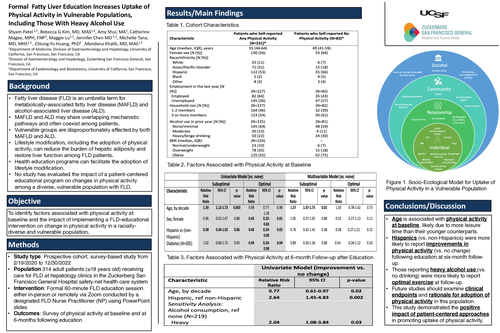
Results: Participant characteristics in those without vs. with any physical activity were as follows:
median age 49 vs. 55 years, 64% vs. 56% female, 66% vs. 53% Hispanic, 75% vs. 55% obese, and 30% vs.
22% endorsed heavy alcohol use, respectively. On multivariable analysis, older age was the only factor
associated with physical activity at baseline (RRR 1.37 per decade, 95% CI 1.07-1.75). Hispanic (vs. non-
Hispanic) participants had a significantly higher probability of reporting improvement in physical activity
(vs. no change) six months after education (RRR 2.36, 95% CI 1.27-4.39). Among those with suboptimal
or no physical activity at baseline, only participants who reported heavy alcohol use (vs. no drinking) had
a higher likelihood of achieving optimal physical activity following education (RRR 1.98, 95% Cl 1.05-
3.74).
Discussion: Despite known social and structural barriers to adopting physical activity, formal FLD
education increased uptake of physical activity in vulnerable populations, especially among Hispanics
and those reporting heavy alcohol use. Efforts to implement patient-centered education is important to
FLD management.