145 posters, 12 topics, 25 sessions, 145 authors
ePostersLive by SciGen Technologies S.A. All rights reserved.
UCSF 2023 Inquiry Symposium
10 May | University of San Francisco

P070
Implementation of Mobile Medical Pregnancy Care Through Community Engagement and Partnership
Part of Topic
Systems Science
Title:
Implementation of Mobile Medical Pregnancy Care Through Community Engagement and Partnership
Introduction:
Inequity of birth experience and outcomes in America is a pervasive problem, one deeply rooted in
systemic racism and injustice. Prior to the start of this project, a Human Centered Design process was
undertaken in order to understand the challenges facing Medicaid-insured pregnant people in San
Francisco and to design interventions to address these challenges (Nijagal 2021). In this process,
researchers led focus groups with members of the community who were pregnant, had recently been
pregnant, or were partnered with someone who was pregnant. One of the three community designed
solutions was to deliver co-located pregnancy-related care and services into high-need neighborhoods as
a one-stop shop. Working alongside the community, this was implemented as a “Pop-Up Village”
occurring once monthly in the Bayview neighborhood and includes food services, community support
services, and access to city resources. Given that one of the community identified solutions was to
deliver co-located care alongside these services, the aim of this project was to determine what clinical
services were desired by the community and to determine practicality of this implementation.
Aims:
- Using community based design, establish which clinical services are desired by community
members at the Pop-Up Village in the Bayview neighborhood of San Francisco.
- Assess available resources to determine practicality of implementing desired clinical services.
Project Design:
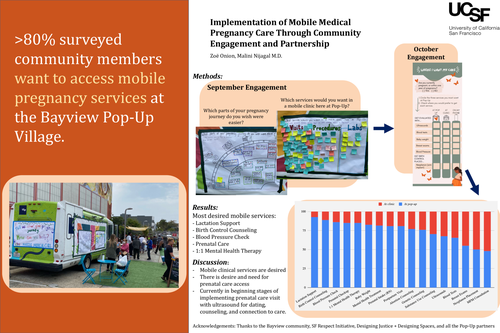
We implemented our community engagement in two phases. In the first phase, we brought a borrowed
clinical mobile unit to the Pop-Up Village and, using open ended questions, engaged the community to
think about (1) the challenges they experience in prenatal care and (2) what services they would be
interested in receiving at the Pop-Up Village rather than in a traditional clinic. We designed posters with
each question and asked each community member to share their answers on post-it notes. In our second
phase, we established a questionnaire based on the responses from the first phase and surveyed
community members about where they would most like to receive specific clinical services; at Pop-Up or
in a traditional clinic setting.
Results:
Phase One:
The top five services identified as “could be easier to access” were: mental health services, labor
planning, social support for pregnancy, prenatal intake, and ultrasounds. The services identified as
“would access at Pop-Up” were: Ultrasound, Blood tests, Breast exams, Pregnancy tests, and Blood
pressure monitoring.
Phase Two:
>50% of all community participants stated they would access all of the services at Pop-Up Village. The
most desired services were: lactation support, birth control counseling, blood pressure check, prenatal
check-up, and 1:1 mental health therapy, with >80% of participants stating they would receive each of
these services at a mobile unit at the Pop-Up Village.
Discussion:
These results from this community engagement project supported the results from Nijagal et al.’s work in
2021, establishing further that clinical care is desired in the community setting, co-located with other
pregnancy services. Amongst the services identified, there was a strongly expressed need for better
access to mental health services. There also was a desire for multiple components of prenatal care,
including prenatal intake, ultrasounds, pregnancy tests, and counseling and support services. These
results were presented to the Director of Ambulatory Care at the San Francisco Health Network. The
SFHN was excited about the community interest in mobile prenatal care services and felt that
implementation of an access point for prenatal care would be feasible and have great impact, aligning
with community desires. The next step of this project is currently underway, implementing a trial period
of a “landing visit” at the Pop-Up Village for newly pregnant people to access ultrasound for dating,
receive counseling, and to be scheduled for prenatal care at the health system of their choice. There are
additional efforts underway through other partners at the Pop-Up village to improve access to mental
health services