145 posters, 12 topics, 25 sessions, 145 authors
ePostersLive by SciGen Technologies S.A. All rights reserved.
UCSF 2023 Inquiry Symposium
10 May | University of San Francisco

P066
Medical Trainee Perspectives Around Racism Experienced by Black Adults Near the End of Life
Part of Topic
Social & Behavioral Sciences
Introduction:
Black Americans are less likely to receive goal-concordant end-of-life care, in part due to racial
disparities such as inadequate pain treatment and reduced access to palliative care. Medical
trainees spend a significant time with patients, families, and in clinical environments. They may
provide a unique perspective that informs efforts to address structural racism.
Hypothesis: Medical trainees will have had clinical experiences caring for Black patients near
the end of life that show how racism and structural racism negatively impact Black patients’
and families’ experiences.
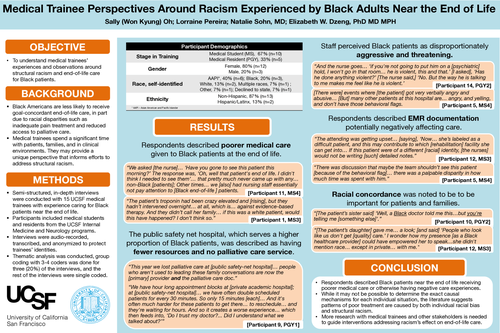
Aims: To understand medical trainees’ experiences and observations around structural racism
and end-of-life care for Black patients.
Project Design/Methods: Semi-structured, in-depth interviews were conducted with 15 UCSF
trainees (medical students or residents) with experience caring for Black patients near the end
of life. Participants included medical students and residents from the UCSF Internal Medicine
and Neurology programs. Sixty-seven percent (n=10) of respondents were medical students
(67%), while 33% (n=5) were medical residents. Medical students were in their third or fourth
years of the program (70% and 30%, respectively), while residents were in their first, second,
or third years of Internal Medicine or Neurology residency. Respondents racially identified as
Asian American or Pacific Islander (40%, n=6), Black (20%, n=3), White (20%, n=3), Other (7%,
n=1), Multiple Races (7%, n=1), or declined to state (7%, n=1). Eighty percent (n=12) of
respondents were female, while 20% (n=3) were male. Interviews were audio-recorded,
transcribed, and anonymized to protect trainees’ identities. Thematic analysis was conducted,
group coding with 3-4 coders was done for three (20%) of the interviews, and the rest of the
interviews were single coded.
Results/Product:
Respondents described poorer medical care given to Black patients at the end of life. The
public safety net hospital, which serves a higher proportion of Black patients, was described as
having fewer resources and no palliative care service. Staff perceived Black patients as
disproportionately aggressive and threatening. Respondents described EMR documentation
potentially negatively affecting care. Racial concordance was noted to be to be important for
patients and families.
Discussion/Conclusion:
Respondents described Black patients near the end of life receiving poorer medical care or
otherwise having negative care experiences. While it may not be possible to determine the
exact causal mechanisms for each individual situation, the literature suggests patterns of poor
treatment are caused by both individual racial bias and structural racism. More research with
medical trainees and other stakeholders is needed to guide interventions addressing racism’s
effect on end-of-life care.