145 posters, 12 topics, 25 sessions, 145 authors
ePostersLive by SciGen Technologies S.A. All rights reserved.
UCSF 2023 Inquiry Symposium
10 May | University of San Francisco

P065
Surface Level: A Collection of Short Stories
Poster Presenter
Authors
Part of Topic
Social & Behavioral Sciences
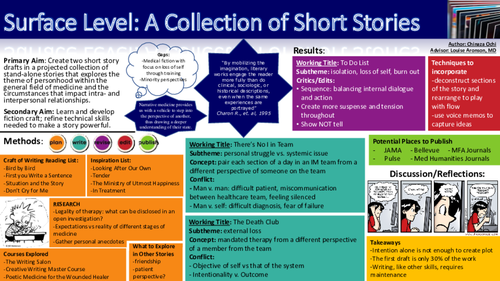
For my deep explore project, I set out to develop a work of fiction that explores personhood within medicine. Specifically, I wanted to write stories around circumstances that can feel both unique and common as healthcare professionals, while underlining the impact that it has on intra- and interpersonal relationships. As a Black woman in medicine, I also wanted to uplift marginalized voices within my prose. The craft of fiction allows me to do this while engaging readers in a more personal way. Thus, I proposed that within the allotted time, I will create two short story drafts in a projected collection of stand-alone stories. Along the way, I also aimed to learn more about fiction writing in general as I sharpened the skills required to be a great writer.
As somebody that has written short stories in the past, I entered my deep explore period expecting to pick up where I left off. I imagined, with the right inspiration, I would be able to go above and beyond my goals, possibly having the entire collection close to ready for submission by the end of my dedicated period. I started my first short story working in a third person omniscient point of view to allow for insight into multiple characters simultaneously. Additionally, with this point of view, I could create more dramatic irony, when the reader has information that the characters do not, in order to pull the reader further in the story. I planned to use time jumps as an additional technique to further the impact of the story. Having limited experience writing in this point of view in the past, I expected it would take a bit of a learning curve. I read different anthologies, highlighting the techniques the author used that worked and the ones that pulled me out of the narrative. I watched shows and researched topics relevant to the characters that I could use to make their situation more realistic, then refined the plot as I went along. However, within the first couple of paragraphs of me sitting down and writing, I realized that I was rusty, and no amount of grease was going to get the wheel going. The learning curve I expected was much steeper than third person omniscient point of view. I had to go back to the basics. I had to relearn how to write, or so it felt, and that feeling was paralyzing. Everything started to feel more difficult, even techniques I was previously comfortable with. My dialogue felt flat, my descriptions sounded boring, and my characters one dimensional, the exact opposite of what I was trying to accomplish. I felt discouraged.
Upon talking to my mentor and brainstorming with peers, I learned that my feelings were stemming from perfectionism, over-ambition and insecurity while I was dealing with immense burn out. How was I to get past that? Write it down. In fact, it was proposed to me to write the worst thing that I could think of as long as there were words on a paper. As I started writing I ran into another obstacle, writer’s block or as I like to call it, a writer’s worst nightmare, especially a writer on a deadline. The story did not feel like it had a direction. This led to another pathway of discovery that what I had were intentions but not a story. I knew what I wanted to communicate to an audience but to write a compelling short fiction story requires more than that. It needs plot and in the words of Anne Lamott “plot grows out of character” so I switched gears once again. I spent time working on the characters, constantly asking myself, who are they? What are their motivations? Their hope, dreams and fears? What are they going through that they are not communicating? How do I show that in an authentic way? The answers to these questions brought the dissolvement of the story I was imagining into two distinct stories and the conception of a third story. The plot that emerged turned out to be different than what I initially conceptualized. It was much better.
By the end of the deep explore period, I partially achieved my goals. I completed a draft of one story, which is now entering the revising process, and started writing another short story. My goal of completing two drafts turned out to be a loftier goal than I expected and required more emphasis on my secondary aim of sharpening my fiction writing craft skills than I predicted. I almost fell into the trap of thinking that doing a creative short story project would be a simple task, but, in the words of my mentor Dr. Aronson, the first draft is only 30% of the work. Behind the scenes there is so much time and energy that goes into conceptualizing, researching, observing, documenting, organizing, learning, unlearning then relearning, editing, and refining the work before it can reach the standard for submission, and even then, there are still ways it can be improved. This also does not consider the courage required to believe in yourself to be able to do it all. I am fortunate I had a great mentor and a cohort of peers that inspired and supported me through this process. It’s been refreshing to get back into writing and to be able to use this deep explore period to dust off the creative storytelling part of my brain and to sharpen it further. I learned more about myself as a writer, and through my characters, also reflected on the ways medicine has shaped me and those around me, which is what I hope for future readers to be able to do themselves when reading this collection of short stories. As I further learn and hone my literary skills, I hope to continue to use the amazing techniques fiction offers to spur dialogue around who we are within medicine and highlight the minority voices that do not often get a chance in the spotlight.