145 posters, 12 topics, 25 sessions, 145 authors
ePostersLive by SciGen Technologies S.A. All rights reserved.
UCSF 2023 Inquiry Symposium
10 May | University of San Francisco

P056
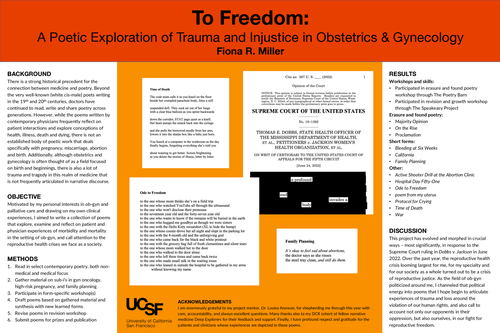
To Freedom: A Poetic Exploration of Trauma and Injustice in Obstetrics & Gynecology
Poster Presenter
Authors
Part of Topic
Social & Behavioral Sciences
Project Reflection March 2023
One evening a few months ago, when I was in the thick of my Deep Explore project time and working daily on these poems, I shared an update during my family’s nightly “news of the day” dinner table report. “That sounds cool,” my 9-year-old daughter reassured me. “But what does poetry have to do with medical school?”
I had asked myself the same question when I first began to contemplate this project in the fall of 2021. It seemed improbable at best that I would be allowed (much less encouraged) to embark on a narrative medicine poetry project for my Deep Explore requirement. As a comparative literature and poetry major in undergrad and a lifelong writer, I knew that nothing sounded more exciting to me than exploring through poetry the themes and issues I care about in medicine – but the chance to actually do it seemed almost too far-fetched.
I was very fortunate to have a strong circle of advisors and mentors around me who encouraged me to go for it (especially Dr. Brie Williams and Dr. Sara Newmann), a wonderfully thoughtful and supportive DCR small group leader who helped me conceptualize and drill down on both the big ideas and little details (Dr. Ashley McMullen), and an amazing Deep Explore mentor who has shepherded me through this project with care, support, accountability, and always-excellent questions (Dr. Louise Aronson). Without all of them, I couldn’t have actually done it.
When considering my original goals for this Deep Explore project, I have accomplished what I set out to do. I aimed to write a collection of original poems that explored patient and physician experiences of illness, disability and death in the field of obstetrics and gynecology, relying on my own experiences as a third- and fourth-year medical student rotating through ob-gyn specialties. This work was intended to be grounded in a thoughtful reading of contemporary poets whose work resonates with my own themes, style and purpose, and to be disseminated through both medical and non-medical literary platforms.
In big picture terms, this is what I have done. I began my Deep Explore project time with deep reading, focusing on several poets I had identified in my proposal (Tracy K. Smith, Aracelis Girmay, Demetria Martinez, Claudia Rankine, Danez Smith) as well as others I had not (Ocean Vuong, many poets from the anthology Black Girl Magic). I spent several months taking notes and writing down ideas, observations and fragments as I rotated through my ob-gyn subinternships in gyn oncology, high-risk pregnancy and family planning, as I had proposed to do. I wrote the beginnings, middles and/or ends to many poems, of which about 13 have taken on a final form. I participated in an intensive revision workshop through The Speakeasy Project, where I was able to workshop many of my poems with fellow poets through critique and revision. And I have begun to submit individual poems for recognition and publication, including so far to the Williams Carlos Williams Poetry Competition and The Missouri Review’s Perkoff Prize, with more submissions planned for the coming months. 2
Over the past year of working on this project, I’ve learned a lot. Literally, I learned a new poetic form: I enrolled in a workshop through The Poetry Barn called Writing Resistance Through Erasure, Found Text and Visual Poetry, in which I read, studied and practiced different forms of erasure and found poetry. The lessons gleaned in this workshop were reflected in three of the poems in the final collection. Logistically, I learned (or perhaps was reminded) that everything takes longer than you think it will: I ended up writing fewer poems than proposed, although this was partially due to completing fewer Deep Explore weeks than originally planned.
But the most important lesson I took away from this project is the same lesson every writing project has taught me: art and life do their interconnected thing, and as a creator, I’m basically just along for the ride. Although I did execute on the fundamental plan I laid out one year ago, the project has evolved and morphed in crucial ways – most significantly, in response to the Supreme Court ruling in Dobbs v. Jackson last June that overturned the precedent of Roe v. Wade and eliminated the constitutional right to abortion. When I submitted my project proposal in March of 2022, the leak of the Supreme Court draft opinion, and the subsequent ruling, were still months away. The ruling came down on the last day of my rotation on the high-risk pregnancy service, and one month later, I started my sub-internship in the abortion clinic.
The swirl of emotion, conversation and activism around the fight for abortion rights during this time, and the ways in which that swirl influenced my approach to my clinical work, steered the project in a new direction. Where it had set out to engage with experiences of morbidity and mortality in the field of ob-gyn at large, it ended up centering strongly on one subset within that field. In a way, this heightened focus on abortion concentrated the project’s attention to issues of inequity and injustice. My hope, as I wrote in my project proposal, was that “this body of poetic work will call attention to the reproductive health crises we face as a society” – over this past year, the reproductive health crisis looming largest for me, for my specialty and for our society as a whole turned out to be a crisis of reproductive justice. As the field of ob-gyn politicized around me, I channeled that political energy into poems that I hope begin to articulate experiences of trauma and loss around the violation of our human rights, and also call to account not only our opponents in their oppression, but also ourselves, in our fight for reproductive freedom. As James Baldwin wrote, “It doesn’t do any good to blame people or the time – one is oneself all those people. We are the time.”
At this stage of the project, what excites me most is that it’s not over. Beyond my plans for ongoing dissemination of this work in a timely and relevant moment in history, I see it as something akin to the kick-off of my career as a physician-writer, which has been my goal ever since I first decided to pursue medicine. In the spring of 2009, when I submitted my poetry thesis as a college senior, my advisor Jim Richardson told me, “It might be a while until you write another poem. Don’t worry.” I worried a lot in the ensuing months and years, but could have had no way of knowing that I would write another collection of poems, also as a capstone project – this time, for medical school. If anything, what I’ll take away from this project is proof (and a precedent) that it’s possible to do medicine and also do poetry. I am tremendously grateful to have had the opportunity to engage in this creative work for my Deep Explore project, and I’m looking forward to continuing it over the rest of my career. In the words of the poet Tony Hoagland, “What I thought was an end turned out to be a middle.” Here’s to narrative medicine, to the middle, and to everything that comes next.