145 posters, 12 topics, 25 sessions, 145 authors
ePostersLive by SciGen Technologies S.A. All rights reserved.
UCSF 2023 Inquiry Symposium
10 May | University of San Francisco

P147
Patient and Provider Perspectives on Informed Consent Prior to Cesarean Delivery: A Mixed-methods Study in Uganda
Poster Presenter
Authors
Part of Topic
Population Science & Epidemiology
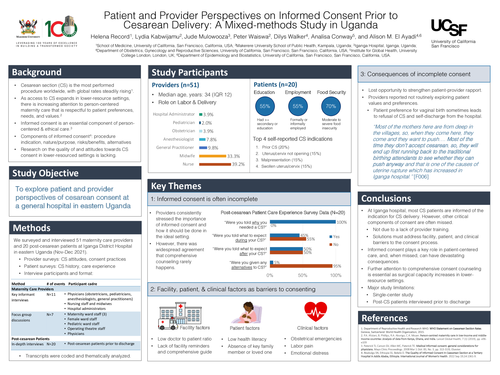
Title: Patient and provider perspectives on informed consent prior to cesarean section: a mixed-methods study in Uganda
Background: Informed consent prior to cesarean section is an essential component of person-centered care, yet it is not always obtained. Facility and patient-level factors can inhibit the quality of the consent process, especially in lower-resource settings. In this study, we aimed to describe and compare healthcare provider and patient perspectives of cesarean section consent at a general hospital in eastern Uganda.
Methods: We collected mixed-methods data between November 2021 and February 2022 from cesarean care providers (n=48) and post-cesarean patients (n=20). A sociodemographic and care-perspective survey was administered to all participants. Provider perspectives were assessed via key-informant interviews (n=11) and cadre-specific focus group discussions (n=7). Patient experiences were evaluated via in-depth interviews (n=20). Interview and focus-group transcripts were thematically analyzed.
Results: Both cesarean care providers and post-cesarean patients acknowledged incomplete consent counseling as a significant issue despite routine documentation of written consent. Prior to surgery, 45% of patients reported not being told what to expect during the procedure and 95% reported not receiving counseling on alternatives to cesarean section. While providers emphasized the importance of a comprehensive consent discussion, most agreed that current counseling practices are often inadequate. Commonly perceived barriers to obtaining fully informed consent include heavy workload, time constraints, clinical urgency, low patient health literacy, and lack of a standardized consent tool.
Conclusions: Our findings highlight key barriers to providing fully informed cesarean consent in a low-resource setting. Further efforts are needed to optimize the consent process to advance person-centered maternity care globally.