145 posters, 12 topics, 25 sessions, 145 authors
ePostersLive by SciGen Technologies S.A. All rights reserved.
UCSF 2023 Inquiry Symposium
10 May | University of San Francisco

P100
The increasing prevalence of Neisseria gonorrhea sexually transmitted infections among female Pacific Islanders of the Western Pacific Region
Poster Presenter
Authors
Part of Topic
Population Science & Epidemiology
Introduction: The World Health Organization estimates that annually there are 374 million new cases of sexually transmitted infections (STIs), of which over 60 million occur in the Pacific Island Countries and Territories (PICT) of the Western Pacific Region (WPR). Neisseria gonorrhoeae is the second most common bacterial STI worldwide and is of particular concern due to the significant health burdens associated with infections if left untreated. Further, the majority of women with gonorrhea are asymptomatic, and many infections remain undiagnosed and untreated with the potential for ongoing spread. Few studies have been conducted in PICT where syndromic management is practiced, therefore the prevalence and risk factors for gonorrhea among ethnic Pacific Islanders therefore remain unknown. Epidemiological data on these infections are critical to inform the design of appropriate control strategies and equitable resource allocation for STI prevention, diagnosis, and treatment for Pacific Islanders.
Hypothesis: There will be a high prevalence of gonorrheal STIs among young women in Fiji.
Aims: To assess the current prevalence and risk indicators of gonorrheal STIs among young women attending Fijian Ministry of Health & Medical Services (MoH&MS) health clinics across the Central District of Viti Levu, Fiji.
Project Design/Methods: To address these gaps in knowledge, a cross-sectional bio-behavioral study was conducted that enrolled sexually active women between 18-40 years old from February 2018 to December 2022 in the Central Division of Viti Levu. Socio-demographic and behavioral data were collected to assess risk indicators for infection. Participants underwent pelvic exams and vaginal samples were tested for N. gonorrhoeae, Chlamydia trachomatis, Trichomonas vaginalis, candida and bacterial vaginosis. Trained clinicians collected data on patient symptoms and signs of STIs during clinical examination. Women who tested positive for infections were provided with treatment according to MoH&MS guidelines. Analyses included bivariate and multivariate logistic regression.
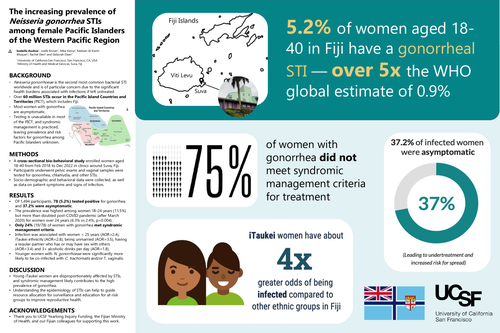
Results/Product: Overall, 1,494 participants were enrolled in the study. The median age for enrolled women was 29 years, and most women self-identified their ethnicity as iTaukei Fijian (n=819 [54.8%]), Indo-Fijian (n=421 [28.2%]), or Other Pacific Islander (n=94 [6.3%]). Of 1,494 participants, 78 (5.2%) tested positive for N. gonorrhoeae; 37.2% were asymptomatic. The prevalence was highest among women 18-24 years (11.5%) but more than doubled post-COVID pandemic (after March 2020) for women over 24 years (6.3% vs 2.4%, p=0.004). Only 24% (19/78) of women with gonorrhea met syndromic management criteria while 92% (223/242) meeting the criteria tested negative. In multivariate analyses, infection was associated with women under 25 years (AOR=2.4), iTaukei ethnicity (AOR=2.8), being unmarried (AOR=3.5), having a regular partner who has or may have sex with others (AOR=3.4) and 3+ alcoholic drinks per day (AOR=1.8). Younger women with N. gonorrhoeae were significantly more likely to be co-infected with C. trachomatis and/or T. vaginalis.
Discussion/Conclusion: The study evaluated the prevalence of N. gonorrhoeae infection among female Pacific Islander ethnic groups in Fiji. Women of iTaukei ethnicity are more likely to have N. gonorrhoeae infection than Indo-Fijian women or other Pacific Islander ethnicities. The prevalence of N. gonorrhoeae infection is over five times greater than the WHO estimated global prevalence of 0.9% for women aged 15-49 years. Syndromic management likely contributes to the high prevalence of gonorrhea. The study found several socio-demographic and modifiable risk factors associated with N. gonorrhoeae infection, including the inaccessibility of barrier contraceptives post-COVID pandemic. The study also showed that over one-third of the women who had gonorrhea were asymptomatic and three-quarters of those infected did not meet the criteria for treatment based on syndromic management, leading to significant undertreatment. Our findings can help to guide resource allocation for surveillance and education for at-risk groups to improve reproductive health for this neglected, vulnerable population. Limitations of the study include the cross-sectional design does not allow for assessing causality of risk factors. Additionally, we only enrolled women in the Central Division of Viti Levu—the most populated region of the archipelago— which may reduce the generalizability of our results to other areas of Fiji and the PICT. Further research including antimicrobial susceptibility testing for N. gonorrhoeae and testing partners and young men in the region are needed to better capture the scope of the problem.