145 posters, 12 topics, 25 sessions, 145 authors
ePostersLive by SciGen Technologies S.A. All rights reserved.
UCSF 2023 Inquiry Symposium
10 May | University of San Francisco

P126
Comparing targeted azithromycin treatment strategies in a trachoma hyperendemic area
Poster Presenter
Authors
Part of Topic
Population Science & Epidemiology
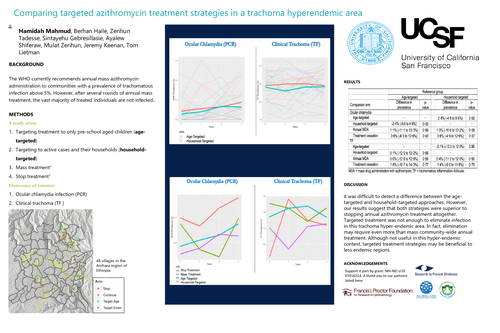
Purpose: The World Health Organization (WHO) currently recommends annual mass azithromycin administration to communities with a prevalence of trachomatous infection above 5%. However, after several rounds of annual mass treatment, the vast majority of treated individuals are not infected. We performed a cluster-randomized control trial to compare two annual targeted treatment strategies: (1) an age-targeted arm of preschool-aged children (6 months-5 years old) and (2) a household-targeted arm of households in which children have clinically active trachoma.
Methods: 48 communities in the trachoma hyperendemic area of Amhara, Ethiopia who previously received annual mass azithromycin distribution, were randomized to one of four arms for three years: (1) age-targeted, (2) household-targeted, (3) annual mass azithromycin, and (4) stop treatment. The primary outcome of interest was PCR prevalence of ocular chlamydia infection and secondary outcome of interest was clinical trachoma (TF), and both were observed in children 0-9 years old.
Results: 4100 children 0-9 years old were monitored annually for ocular chlamydia and clinical trachoma. When corrected for baseline, there was no significant difference between the two targeted treatment arms for ocular chlamydia (mean difference 0.0, 95% CI [-0.1 to 0.1], P=0.49) nor clinical trachoma (mean difference 0.0, 95% CI [-0.1 to 0.1], P=0.98). Targeted treatment communities had non-significantly less infection and clinical trachoma than communities that stopped treatment (mean difference 0.0, 95% CI [-0.1 to 0.1], P= 0.37) and (mean difference 0.0, 95% CI [-0.1 to 0.1], P=0.78) respectively. However targeted communities also had non-significantly more infection and clinical trachoma than communities that continued WHO recommended community-wide annual mass azithromycin distribution (mean difference 0.0, 95% CI [-0.1 to 0.1], P=0.85) and (mean difference 0.0, 95% CI [-0.1 to 0.1], P=0.99) respectively.
Conclusions: We did not detect a difference between the age-targeted and household-targeted treatment approaches. However, our results suggest that targeted treatment is superior to stopping annual azithromycin treatment altogether. Moreover, although targeted treatment was not enough to eliminate infection in this trachoma hyper-endemic region, even WHO guideline annual mass azithromycin distribution may not be sufficient to eliminate the trachoma burden in this area. Thus, targeted treatment strategies may still be beneficial to less trachoma endemic regions facing antibiotic resistance.
Disclosures: N
Support: NIH-NEI U10 EY016214