145 posters, 12 topics, 25 sessions, 145 authors
ePostersLive by SciGen Technologies S.A. All rights reserved.
UCSF 2023 Inquiry Symposium
10 May | University of San Francisco

P127
Disparities in Advance Care Planning Among Older U.S. Immigrants From a Nationally Representative Cohort
Poster Presenter
Authors
Part of Topic
Population Science & Epidemiology
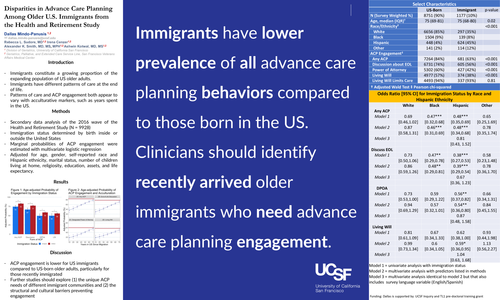
Background: Despite known racial disparities in advance care planning (ACP), little is known about ACP disparities experienced by US immigrants.
Methods: We used data from the 2016 wave of the Health and Retirement Study. We defined ACP engagement as self-reported end-of-life (EOL) discussions, designation of a power of attorney (DPOA), documented living will, or “any” of the three behaviors. Immigration status was determined by participant-reported birth outside the US. Time in the US was calculated by subtracting the year of arrival in the US from the survey year of 2016. We used multivariable logistic regression to estimate the association between ACP engagement and immigration status and the relationship of acculturation to ACP engagement, adjusting for sociodemographics, religiosity, and life expectancy.
Results: Of the cohort, 1,177 (10%) were immigrants; 45% of immigrants identified as Hispanic. After adjustment, immigrants had significantly lower percentage of any ACP engagement (immigrants: 74% vs US-born: 83%, p<0.001), EOL discussions (67% vs 77%, p<0.001), DPOA designation (50% vs 59%, p=0.001) and living will documentation (50% vs 56%, p=0.03). Among immigrants, each year in the US was associated with a 4% increase in the odds of any ACP engagement (aOR 1.04, 95% CI 1.03-1.06), ranging from 36% engaged 10 years after immigration to 78% after 70 years.
Conclusion: ACP engagement was lower for US immigrants compared to US-born older adults, particularly for those that recently immigrated. Future studies should explore strategies to reduce disparities in ACP and the unique ACP needs among different immigrant populations.