145 posters, 12 topics, 25 sessions, 145 authors
ePostersLive by SciGen Technologies S.A. All rights reserved.
UCSF 2023 Inquiry Symposium
10 May | University of San Francisco

P141
Biomimetic Human Tuberculosis (TB) Granulomas: One Step Closer to Unravelling TB Immunopathogenesis?
Poster Presenter
Authors
Part of Topic
Biomedical Science
Introduction:
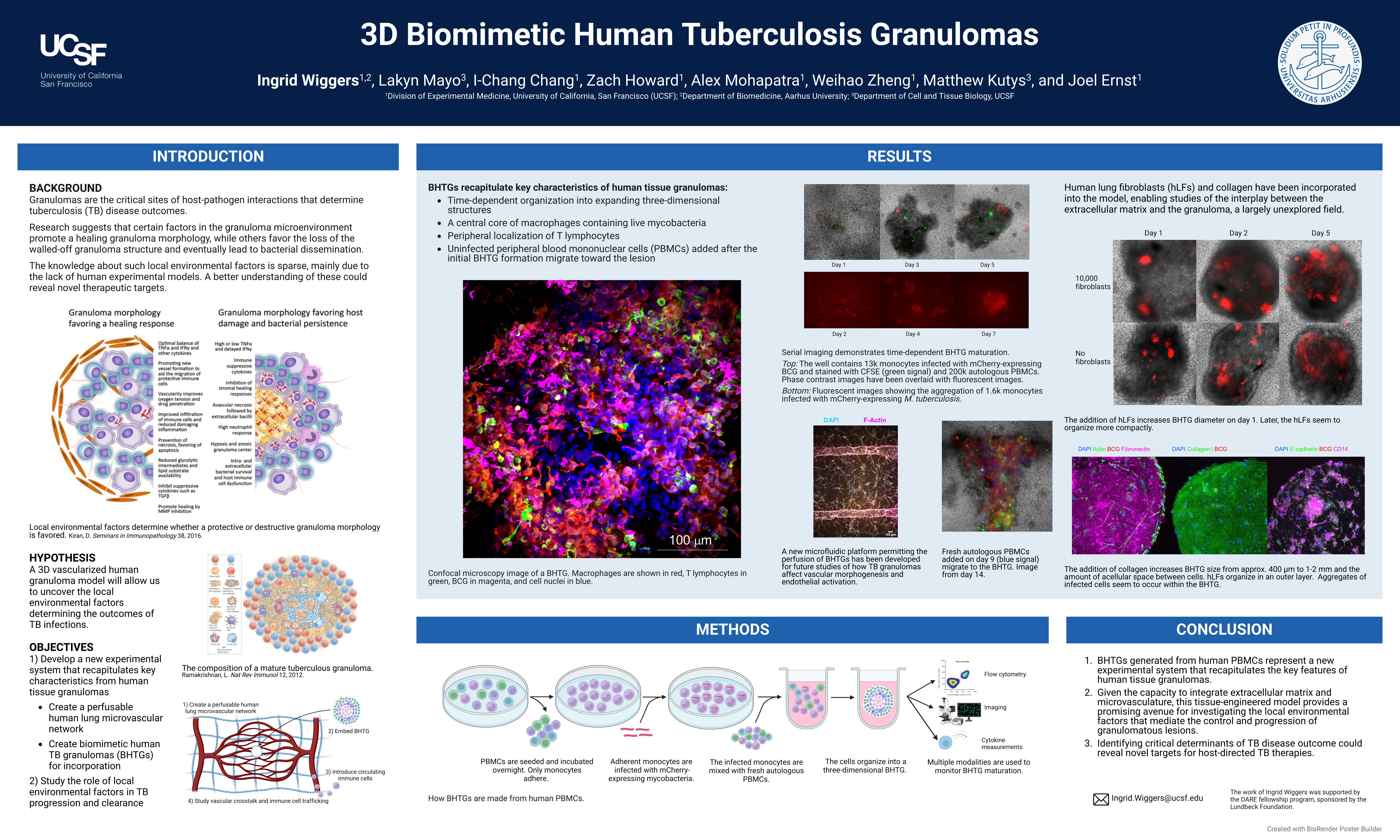
A fundamental barrier to developing novel approaches to tuberculosis (TB) diagnostics and therapies is our failure to understand the mechanisms underlying TB clearance and progression. Granulomas are the critical sites of host-pathogen interactions that determine TB disease outcomes. Research suggests that certain factors in the granuloma microenvironment promote a healing granuloma morphology, while others favor the loss of the walled-off granuloma structure and eventually lead to bacterial dissemination. However, the knowledge about such factors is sparse, mainly due to the lack of human experimental models. A better understanding of the nature of these could reveal novel therapeutic targets.
Hypothesis:
A 3D vascularized human granuloma model will allow us to uncover the local environmental factors determining the outcomes of TB infections.
Aims:
- Develop a new experimental system that recapitulates key characteristics from human tissue granulomas
- Create a perfusable human lung microvascular network
- Create biomimetic human TB granulomas (BHTGs) for incorporation
- Study the role of local environmental factors in TB progression and clearance
Methods:
BHTGs are generated from human peripheral blood mononuclear cells (PBMCs). Monocytes are infected with mCherry-expressing mycobacteria and mixed with fresh autologous PBMCs. Fluorescent microscopy is used to monitor how the cells self-organize into BHTGs over time. Human lung fibroblasts and collagen are added to the model to mimic extracellular matrix. A microfluidic platform for vascularizing BHTGs is developed from endothelial cells, stromal cells, and collagen.
Results/Product:
Here, we introduce a tissue-engineered biomimetic model of human TB granulomas as a new experimental system for studying host-pathogen interactions and identifying novel TB therapies. BHTGs recapitulate key architectural features of human tissue TB granulomas: Time-dependent maturation into expanding three-dimensional structures, a central core of macrophages containing live mycobacteria, and peripheral localization of lymphocytes. Extracellular matrix has successfully been added to the model. Finally, a microvascular device permitting the vascularization of BHTGs has been developed.
Discussion/Conclusion:
We have developed a novel in vitro TB granuloma system using human cells. BHTGs provide a promising avenue for investigating the immunological mechanisms mediating the control or progression of TB. In addition, human lung fibroblasts and collagen have been incorporated into the model, enabling studies of the interplay between the extracellular matrix and the granuloma, a largely unexplored field. Furthermore, a new microfluidic platform permitting the perfusion of BHTGs has been developed for future studies of the impact of TB granulomas on vascular morphogenesis and endothelial activation. Given the high resemblance to human tissue granulomas combined with the capacity to integrate extracellular matrix and microvasculature, this model represents a significant step forward compared to former in vitro approaches.