145 posters, 12 topics, 25 sessions, 145 authors
ePostersLive by SciGen Technologies S.A. All rights reserved.
UCSF 2023 Inquiry Symposium
10 May | University of San Francisco

P139
Race in Clinical Diagnosis and Decision-Making in Health Care: Overview and Implications
Poster Presenter
Authors
Part of Topic
Systems Science
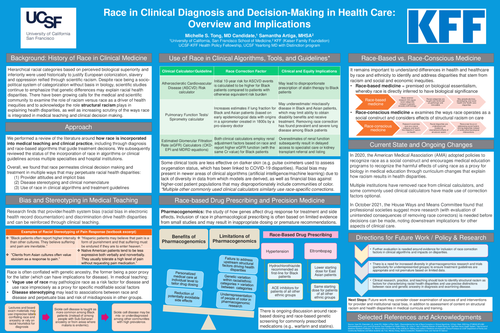
Introduction Hierarchical racial categories based on perceived biological superiority and inferiority were used historically to justify European colonization, slavery and oppression reified through scientific racism. Despite race being a socio-political system of categorization without basis in biology, scientific studies continue to emphasize that genetic differences may explain racial health disparities. There have been growing calls for the medical and scientific community to examine the role of racism versus race as a driver of health inequities and to acknowledge the role structural racism plays in explaining health disparities, as well as increasing scrutiny of the ways race is integrated in medical teaching and clinical decision making.
Hypothesis N/A
Aims: We aimed to review how race is incorporated into medical teaching and clinical practice and characterize the impacts these may have or have had on racial disparities.
Project Design/Methods: We performed a review of the literature around how race is incorporated into medical teaching and clinical practice, including through diagnosis and race-based algorithms that guide treatment decisions. We subsequently reviewed the status of the incorporation of race in algorithms or clinical guidelines across multiple specialties and hospital institutions.
Results: Overall, we found that race permeates medical teaching as well as clinical decision making and treatment in multiple ways that may perpetuate racial health disparities: • Provider Bias and Discrimination. There is substantial research that provider and health system bias and discrimination are drivers of disparities, contributing to racial differences in diagnoses, treatment decisions, and pain management. • Disease Stereotyping and Nomenclature. Some medical training approaches and materials misuse race as a surrogate for genetic ancestry and socioeconomic status and some disease names use racial and geographic terms that can improperly link them to certain communities. 2 • Use of Race in Clinical Algorithms, Tools and Guidelines. Although race is not a reliable stand-in for genetic ancestry, some clinical estimators or algorithms assign differential risks or treatments to patients based on race, which can lead to misdiagnosis and inappropriate treatment. Diagnostic and teaching tools may also lack appropriate representation to allow for accurate diagnosis for certain groups. • Race-based Pharmacological Prescribing Guidelines. Race plays a factor in the dosing and prescribing of certain drugs for patients and the use of race in the emerging field of personalized medical therapy is under growing scrutiny given that genetic variation within racial/ethnic groups can exceed variation across groups.
Discussion: It remains important to understand differences in health and healthcare by race and ethnicity to identify and address disparities that stem from racism and social and economic inequities. Race-based medicine is premised on biological essentialism, whereby race is directly inferred to have biological significance, whereas race-conscious medicine examines the ways race operates as a social construct and considers effects of structural racism on care. Further evaluation is needed around evidence for inclusion of race correction factors in clinical algorithms and impacts on disparities. Furthermore, there is a need for increased diversity in pharmacogenomics research and trials (particularly for underrepresented groups) to ensure treatment guidelines are appropriate and not premature based on limited data. Clinical research, practice, and teaching should look to identify structural racism as factors for characterizing racial health disparities and use precise distinctions between race and genetic ancestry in diagnosis and examining disease.