145 posters, 12 topics, 25 sessions, 145 authors
ePostersLive by SciGen Technologies S.A. All rights reserved.
UCSF 2023 Inquiry Symposium
10 May | University of San Francisco

P136
Rising Facility Fees Drive Emergency Department Cost Growth Relative to Other Outpatient Settings
Poster Presenter
Authors
Part of Topic
Systems Science
INTRODUCTION: Almost half of US adults report delaying medical care due to cost and even for people with health insurance, many ED visits exceed the threshold that consumers can pay without borrowing. After an emergency department visit, both the physician and the facility separately bill for evaluating the patient. The facility bill, or “facility fee,” helps defray the overhead cost of providing 24/7 services and staffing. However, these fees are unregulated, not required to be disclosed to patients, and have come under scrutiny in recent years for their contribution to unaffordable ED bills.
AIMS: To quantify growth in emergency department (ED) facility fees and their contribution to emergency department visit costs, compared to physician offices and urgent care centers.
PROJECT DESIGN: This cross-sectional, retrospective study used insurance claims from the Merative MarketScan Commercial Database, which captures individuals with large employer private health plans across the US, from 2004-2021. Claims for enrollees < 65 years old with at least one year of continuous enrollment were included. Weights were applied to ensure our population was representative of US residents with large employer plans. We examined ED facility and professional evaluation and management (E&M) claims, which include both professional and facility fees, as well as E&M claims in urgent care (UC) and physician offices (which include only professional fees and do not charge facility fees).
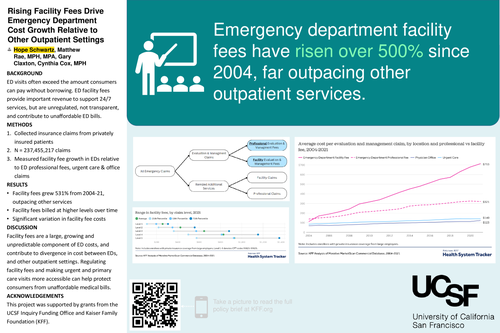
RESULTS: We included 237,455,217 ED evaluation and management claims, which made up 6% of all outpatient E&M claims. Office-based claims accounted for 92% of outpatient E&M, and urgent care claims made up 2%. ED facility fees significantly outpatient ED professional fees, as well as UC and office claims. From 2004 to 2021, the cost of ED facility fees increased 531% from $113 to $713, on average. Meanwhile ED professional fees grew 132%, from $138 to $321, on average. UCs and offices saw more modest growth in their E&M costs, including a 65% cost increase in UCs and an 8% increase in physician offices. Over time, ED facility fees were billed at higher complexity levels, which contributed to rising costs because insurers pay more for more complex services. In 2004, moderate level 2 and 3 fees made up 67% of all facility fees. By 2021, over half of facility fees (55%) were billed as more complex level 4 and 5 fees. Facility fees have also become more expensive at all levels. The average level 5 fee increased from $100 in 2004 to $930 in 2021, while the average level 1 fee increased from $88 in 2004 to $257 in 2021.
DISCUSSION: We find that the average cost of ED services is increasing faster than in other outpatient settings. The disproportionately fast rate of growth in EDs is primarily due to high and rising facility fees, as opposed to professional fees. While these fees provide important revenue for ED operations, there is limited regulation of price setting, billing, and transparency. These fees, which impact virtually everyone who visits an ED, contribute to high visit costs and have driven divergence between the cost of care at EDs compared to UCs or physician offices. Regulating facility fees and making UCs and primary care visits more accessible can help protect consumers from unaffordable medical bills.