145 posters, 12 topics, 25 sessions, 145 authors
ePostersLive by SciGen Technologies S.A. All rights reserved.
UCSF 2023 Inquiry Symposium
10 May | University of San Francisco

P128
The Humanistic Charting Initiative: Standardization of a Patient's Person into the EMR
Poster Presenter
Authors
Part of Topic
Social & Behavioral
Introduction: The standardization of medicine has played a major role in the processes of objectification and commodification in healthcare, strongly contributing to a system of depersonalized care. Standardized tools like the EMR have had positive impacts on care processes and outcomes. Adhering to quality/patient safety methodology, a balancing measure was identified contributing to major issues related to standardization. A measure best described in the form of a question: What is the standard to which we are standardizing? The process of standardization requires consistency and homogeneity in its standard, in the case of medicine, patient populations. With the reality of the U.S., rooted in the beauty of its heterogeneity, directly conflicting with this requirement, it is of no surprise that inequities and disparities exist. The standardization of medicine has become an indispensable part of health care in the U.S., and for that reason it is critical to expand the scope of the standard to which it is designed to best accommodate.
Problem/Question: Information related to a patient’s life outside the health care setting (i.e., their “person”), is often unavailable to health care workers (HCW) prior to a patient encounter and remains unavailable unless solicited from the patient.
Goal: To develop a process/system’s-oriented tool effective in documenting a patient’s “person” and presenting this information to health care providers within the electronic medical record (EMR).
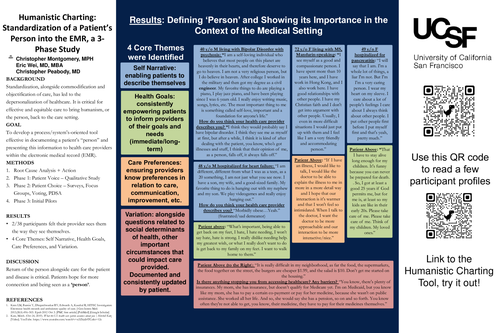
Project Design/Methods: Utilizing patient safety and quality improvement methodology to address depersonalized care, a Root Cause Analysis + Action (RCA2) was completed. Using the Corrective Action Hierarchy, the Humanistic Charting concept was created as an action, centered on addressing systems/process deficits, rather than focusing on the individual. This led to a 3-phase mixed-methods study to create an alternative process of pertinent health care data collection. Phase 1 – Patient Voice: Interviews were completed with 38 patients from seven NYC H+H facilities to explore patients’ perspectives on what key information a HCW should know about their “person” in order to improve care experience and the HCW-patient relationship. Semi-structured grounded theory was used for data analysis. Phase 2 – Patient Choice: Using data from Phase 1, six focus groups with Patient Family Advisory Councils were conducted. Participants created the online tool through activities including voting, open-forum discussion, question design, and tool improvement. Phase 3 – Pilot: The online tool developed in Phase 2 was piloted in multiple health care settings. Pre- and post- surveys were collected from patients, and key informant interviews were conducted with participating HCWs to obtain feedback on the tool design and information presentation. Currently ongoing.
Results/Product: Of the 38 participants interviewed in Phase 1, only two felt their vision of themselves aligns with how they feel seen and treated in health care settings. Participant discussion of care experiences, barriers to care, social drivers of health, and treatment preferences illuminated a critical void in information accessible to HCWs. Four core themes, identified as critical to defining a patient’s ‘person’, were recognized:
- Self-Narrative: enabling patients to describe themselves.
- Health Goals: informing providers of their health goals/needs.
- Care Preferences: informing providers of personal care preferences
- Variation: need to update barriers/life-circumstances that could impact care.
Initial findings from pilots demonstrate positive feedback from both patients and HCWs regarding information collected in the tool and its presentation.
Discussion/Conclusion: With increasingly standardized health care encounters, too often we neglect to collect person centered information. Most believed that providers assumptions negatively impact their care and felt powerless to correct these. Patients hope for more connection and being seen as a ‘person’. Working with patients—the true experts of themselves and effective care improvement—we designed an alternative process of data collection. Considerations to establish and scale Humanistic Charting include integration into the EMR, patient-barriers in tool utilization (primary language, literacy, computer technology/access), and modification to fit different settings, patient populations, and HCW positions.
As a follow up to this study, the tool has been created and is currently in the process of finalizing the implementation of a pilot at Bellevue Hospital, Jacobi Hospital, and Correctional Health Services at Riker’s Island. It is also being piloted at the Parnassus Emergency Department, and in the process of being approved for use in the Med/Surg units at the UCSF Helen Diller Medical Center at Parnassus Heights.