145 posters, 12 topics, 25 sessions, 145 authors
ePostersLive by SciGen Technologies S.A. All rights reserved.
UCSF 2023 Inquiry Symposium
10 May | University of San Francisco

P125
Investigating Anti-Inflammatory Roles of Oxytocin and Secretin on the Ocular Surface
Poster Presenter
Authors
Part of Topic
Biomedical Science
Abstract
Purpose: Oxytocin (OXTR) and secretin receptors (SCTR) have demonstrated anti-inflammatory
and anti-nociceptive roles in various tissues. The purpose of this study is to determine the
presence of OXTR and SCTR within ocular tissues, to establish a basis for anti-inflammatory and
anti-nociceptive roles on the ocular surface.
Methods: Immunofluorescence imaging: Human cornea divided into central (no endothelial
layer) and peripheral (cornea, conjunctiva/sclera) regions were obtained from discarded
transplant materials. Mouse ocular tissues were dissected from wild type C57BL/6J mice. Tissue
sections were stained with anti-OXTR or anti-SCTR primary antibody and Alexa Fluor 488
secondary antibody. Images were taken on a Zeiss LSM900 Airyscan confocal microscope.
Gene expression analysis: Human cornea (4 peripheral, 3 central), tarsus (3), and caruncle (1)
were obtained from discarded surgical tissues. Mouse cornea, conjunctiva, tarsus, retina, and
control (skin, muscle) tissues were extracted from 2 male and 2 female wild type C57BL/6J
mice. RNA was extracted and converted to cDNA for qPCR with primers for human and mouse
Oxtr, Sctr, and control genes (Hprt, Tbp). Relative RNA expression for Oxtr and Sctr in
experimental tissues compared to control tissues (known to have low amounts of Oxtr / Sctr
expression) was determined using Livak analysis.
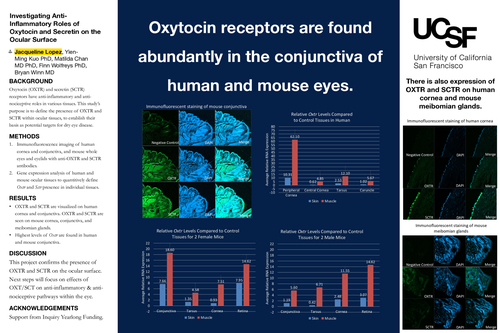
Results: Immunofluorescence imaging shows OXTR and SCTR expression on the epithelial
surface of central and peripheral human cornea and palpebral conjunctiva. Staining also shows
OXTR and SCTR expression in mouse cornea, conjunctiva, and meibomian glands. In humans,
there was higher Oxtr RNA expression in peripheral cornea (62.1x), tarsus (12.1x), caruncle
(5.7x), and central cornea (4.9x) and higher Sctr RNA expression in tarsus (12.2x), peripheral
cornea (8.9x), caruncle (3.3x), and central cornea (1.5x), compared to muscle control tissue. In
female mice, Oxtr RNA showed highest expression in conjunctiva (18.6x) followed by retina
(14.6x), cornea (7.5x), and tarsus (4.6x) compared to muscle control tissue. In male mice, Oxtr
RNA showed highest expression in retina (14.6x), cornea (11.6x), tarsus (6.7x), and conjunctiva
(5.50x) compared to muscle tissue. There was low expression of Sctr RNA in male and female
mice ocular tissues.
Conclusions: OXTR and SCTR are expressed on both the human and mouse ocular surface, with
high levels of OXTR in conjunctiva. This warrants further investigation of the role that OXTR and
SCTR may have in ocular inflammatory and pain pathways.