145 posters, 12 topics, 25 sessions, 145 authors
ePostersLive by SciGen Technologies S.A. All rights reserved.
UCSF 2023 Inquiry Symposium
10 May | University of San Francisco

P122
Cortical and White Matter Associations of OCD Symptomology in a Diverse, Longitudinal Adolescent Cohort
Poster Presenter
Authors
Part of Topic
Biomedical Science
Motivation and Aims
Neuroimaging studies have the potential to advance our understanding of the biological basis of
psychopathology, but their impact has been limited by small sample sizes and methodological heterogeneity
(Marek et al., 2022). This is true for attempts to uncover imaging markers of Obsessive Compulsive
Disorder (OCD), where prior studies have pooled heterogeneously imaged populations and potentially
averaged distinct psychiatric phenotypes by exclusively using categorical measures. (Boedhoe et al., 2018,
Hudziak et al, 2007). By utilizing dimensional measures of psychopathology and high-resolution imaging
analysis, in a large, diverse, longitudinal cohort this study aims to uncover associations between OCD
symptoms, cortical morphology and white matter microstructure.
Methods
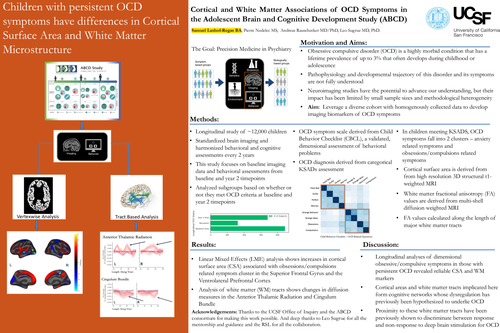
To identify brain associations of OCD we analyzed imaging and psychological data from over
12,000 children enrolled in the Adolescent Brain and Cognitive Development study (ABCD) (Casey et al,
2018). Psychological assessments included both the dimensional Child Behavior Checklist (CBCL) and the
categorical Kiddie Schedule for Affective Disorders and Schizophrenia (KSADS, a DSM derived survey)
allowing cross-validation and independent analysis of their brain-behavior associations (Barch et al, 2018).
Leveraging the large amount of data in ABCD we implemented linear mixed effects models, allowing us to
control for a wide array of potential confounding while analyzing cortical surface area at over 20,000
individual vertices(vertexwise analysis) using Fast and Efficient Mixed Effects Analysis (FEMA) (Fan et al,
2021) derived from structural imaging and Automated Fiber Quantification (AFQ) to analyze white matter
microstructural features extracted from diffusion weighted imaging (Yeatman et al, 2012).
Results
Analysis of the CBCL-OCD scale revealed two distinct symptom clusters: one relating to anxiety
symptoms and the other to obsessions and compulsions. After screening for data quality and missingness
our vertexwise analysis of over 8000 structural MRIs showed significant associations between CBCL OCDspecific symptoms and cortical surface area in the Anterior Cingulate Cortex and the ventrolateral prefrontal
cortex. Analysis of white matter microstructure revealed differences in fractional anisotropy (FA) along the
Anterior Thalamic Radiation, Cingulum Bundle, and Anterior Corpus Collosum. These effects were
strongest in subjects who met KSADS OCD criteria at both imaging time points compared with groups that
never met OCD criteria or in those who met criteria for OCD at one, but not the other, imaging timepoint.
The same analysis showed no difference between these groups in non-limbic tracts such as the Corticospinal
Tract or in the Occipital Corpus Collosum, suggesting an effect that is specific to OCD symptomology.
Discussion/Conclusion
We find that adolescents who meet criteria for OCD at both baseline and 2-year time points show
regionally specific associations between the severity of obsessive-compulsive symptoms and both cortical
surface area and white matter microstructure (FA). These structures have previously been implicated in the
pathophysiology of OCD and their recruitment has been shown to discriminate between responders and
non-responders to Deep Brain Stimulation (DBS) for OCD (Li et al., 2020). Beyond these brain-behavior
associations our results show the potential of methodologically rigorous, longitudinal studies to uncover
imaging markers of psychopathology that might improve personalized diagnosis and treatment.
References
Barch, D. M., Albaugh, M. D., Avenevoli, S., Chang, L., Clark, D. B., Glantz, M. D., Hudziak, J. J., Jernigan, T. L., Tapert, S. F., Yurgelun-Todd, D., Alia-Klein,
N., Potter, A. S., Paulus, M. P., Prouty, D., Zucker, R. A., & Sher, K. J. (2018). Demographic, physical and mental health assessments in the adolescent
brain and cognitive development study: Rationale and description. Developmental Cognitive Neuroscience, 32, 55–66. https://doi.org/10.1016/j.dcn.2017.10.010
Boedhoe, P. S. W., Schmaal, L., Abe, Y., Alonso, P., Ameis, S. H., Anticevic, A., Arnold, P. D., Batistuzzo, M. C., Benedetti, F., Beucke, J. C., Bollettini, I., Bose,
A., Brem, S., Calvo, A., Calvo, R., Cheng, Y., Cho, K. I. K., Ciullo, V., Dallaspezia, S., … ENIGMA OCD Working Group. (2018). Cortical Abnormalities
Associated With Pediatric and Adult Obsessive-Compulsive Disorder: Findings From the ENIGMA Obsessive-Compulsive Disorder Working Group. The
American Journal of Psychiatry, 175(5), 453–462. https://doi.org/10.1176/appi.ajp.2017.17050485
Casey, B. J., Cannonier, T., Conley, M. I., Cohen, A. O., Barch, D. M., Heitzeg, M. M., Soules, M. E., Teslovich, T., Dellarco, D. V., Garavan, H., Orr, C. A.,
Wager, T. D., Banich, M. T., Speer, N. K., Sutherland, M. T., Riedel, M. C., Dick, A. S., Bjork, J. M., Thomas, K. M., … Dale, A. M. (2018). The
Adolescent Brain Cognitive Development (ABCD) study: Imaging acquisition across 21 sites. Developmental Cognitive Neuroscience, 32, 43–54.
https://doi.org/10.1016/j.dcn.2018.03.001
Fan, C. C., Palmer, C. E., Iversen, J. R., Pecheva, D., Holland, D., Frei, O., Thompson, W. K., Hagler, D. J., Andreassen, O. A., Jernigan, T. L., Nichols, T. E., &
Dale, A. M. (2021). FEMA: Fast and efficient mixed-effects algorithm for population-scale whole-brain imaging data [Preprint]. Neuroscience.
https://doi.org/10.1101/2021.10.27.466202
Hudziak, J. J., Achenbach, T. M., Althoff, R. R., & Pine, D. S. (2007). A dimensional approach to developmental psychopathology. International Journal of Methods in
Psychiatric Research, 16(S1), S16–S23. https://doi.org/10.1002/mpr.217
Li, N., Baldermann, J. C., Kibleur, A., Treu, S., Akram, H., Elias, G. J. B., Boutet, A., Lozano, A. M., Al-Fatly, B., Strange, B., Barcia, J. A., Zrinzo, L., Joyce, E.,
Chabardes, S., Visser-Vandewalle, V., Polosan, M., Kuhn, J., Kühn, A. A., & Horn, A. (2020). A unified connectomic target for deep brain stimulation in
obsessive-compulsive disorder. Nature Communications, 11(1), Article 1. https://doi.org/10.1038/s41467-020-16734-3
Marek, S., Tervo-Clemmens, B., Calabro, F. J., Montez, D. F., Kay, B. P., Hatoum, A. S., Donohue, M. R., Foran, W., Miller, R. L., Hendrickson, T. J., Malone, S.
M., Kandala, S., Feczko, E., Miranda-Dominguez, O., Graham, A. M., Earl, E. A., Perrone, A. J., Cordova, M., Doyle, O., … Dosenbach, N. U. F. (2022).
Reproducible brain-wide association studies require thousands of individuals. Nature. https://doi.org/10.1038/s41586-022-04492-9
Yeatman, J. D., Dougherty, R. F., Myall, N. J., Wandell, B. A., & Feldman, H. M. (2012). Tract Profiles of White Matter Properties: Automating Fiber-Tract
Quantification. PLOS ONE, 7(11), e49790. https://doi.org/10.1371/journal.pone.0049790