145 posters, 12 topics, 25 sessions, 145 authors
ePostersLive by SciGen Technologies S.A. All rights reserved.
UCSF 2023 Inquiry Symposium
10 May | University of San Francisco

P118
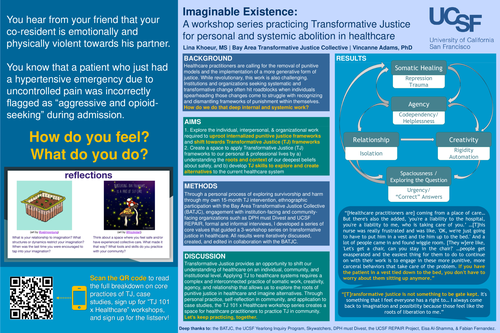
Imaginable Existence: A workshop series practicing Transformative Justice for personal and systemic abolition in healthcare
Poster Presenter
Authors
Part of Topic
Social & Behavioral
Introduction
Increasing recognition of the negative effects of both overt and implicit punitive justice has led healthcare providers to call for the removal of police systems and punitive justice models and the simultaneous increase of resources towards de-escalation trainings and involvement of mental health providers, social workers, and community members. These new methods bring the healthcare system closer to a model of transformative justice (TJ). TJ requires a fundamental shift away from ideologies of punishment, yet little research has investigated how we actually shift the underlying culture of healthcare towards transformative justice. Even less research has explored the difficult physical and psychological experiences of unlearning internalized “truths” about punishment and accountability. While rarely documented, this struggle of personal change and growth is often at the crux of creating sustainable communities unconditionally invested in the health of the individual and collective.
Aims
1. Explore the individual, interpersonal, and institutional work required to unroot internalized frameworks of punitive justice and shift towards Transformative Justice (TJ) frameworks
2. Create a space to apply TJ frameworks to our personal & professional lives by a) understanding the roots and context of our deepest beliefs about safety, and b) develop TJ skills to explore and create alternatives to the current healthcare system
Project Design/Methods:
Over 15 months, I investigated methods of TJ using auto-ethnography, participant observation, detailed open-ended interviews, and ethnographic participation. I participated in organizations dedicated to forms of abolition and addressing/repairing medical harm DPH must Divest, the UCSF REPAIR project, and Skywatchers. As an apprentice of the Bay Area Transformative Justice Collective (BATJC), I learned frameworks of TJ, facilitated trainings, and engaged in direct TJ interventions as well as larger community accountability processes. Through an iterative process with the BATJC, I developed an analytic index of TJ frameworks, identified how they may apply to healthcare systems, and crafted a workshop series for healthcare professionals that wove together the experiences and insights of the BATJC with historical context and a current understanding of the broader sociopolitical landscape in medicine.
Results/Product:
I discovered five key components to engaging with the work of transformative justice:
Somatic practice:
When facing accountability and harm, there is often a feeling of tension and panic that threatens our worldview, and sometimes, our sense of safety (especially in systems of punitive justice, e.g. cancel culture, incarceration, and isolation.) Without understanding how harm, accountability, and punitive justice feel in the body, we are unable to discern between what feels uncomfortable and what feels unsafe. TJ invites us to sit with the feelings that arise and to explore their roots.
Agency:
We cannot force anyone to take accountability for harm, violence, or abuse. However, we can create conditions that foster agency, where people feel empowered to take responsibility for their actions, as well as understand the cultures of harm that influenced the behavior.
Relationship:
A barrier that prevented interviewees from engaging with TJ was the feeling that they were alone. There were few people in their workplace or in their life who shared the same values, and often no one, especially in positions of power, that they could trust to talk about TJ.
Creativity:
TJ responses require flexibility, adaptivity, and creativity to meet each distinct case of harm and utilize the resources available to meet peoples’ needs for support and accountability. It also means trying something, (often) failing, and continuing to imagine.
Exploring the question:
When being called out, called in, and/or confronted with harm, many people and organizations try to resolve the situation as quickly as possible. TJ invites us to first move quickly to meet everyone’s basic needs. Then, TJ asks us to pause, ground in the reality of the conflict or harm, get clear on the question we need to be asking, and explore all possibilities to that question.
This workshop series has run in Spring 2022 and Fall 2022 with a total of 76 participants. Many participants shared that this series helped them take accountability in medical interactions, and in some cases, even address histories of domestic violence and harm in their own lives. A third workshop is planned for April-May of 2023, and I will be training past participants who expressed interest so that they can develop agency in bringing this series back to their communities.
Discussion/Conclusion:
Through ethnographic participation, research, and assessment, it became clear that the academic/intellectual exercise of thinking through transformative justice is not the core, nor the barrier to engaging in TJ. The struggle is in understanding and moving through the felt and lived reality of confronting our deepest beliefs about safety, flexibility, and trust. The workshop series not only supported participants in understanding TJ in healthcare, but also helped them begin the practice and the struggle. The series helped participants develop skills around the five key components of TJ as a community of learners. This series was beneficial for many participants, but it will be important to assess the utility of the workshop series by formally evaluating participants’ ability to bring these skills into their lives to address real conflict and harm.
One limitation of this study is that TJ is not practiced the same way among all communities, and this research and workshop series were derived specifically from people thinking about TJ and medical harm in the context of UCSF and the Bay Area. Future research may explore these methods with other TJ and medical organizations nationally and internationally. A future study may also assess the skills and training needed to empower participants to bring TJ back to their communities and continue building, exploring, and most importantly, practicing transformative justice.