145 posters, 12 topics, 25 sessions, 145 authors
ePostersLive by SciGen Technologies S.A. All rights reserved.
UCSF 2023 Inquiry Symposium
10 May | University of San Francisco

P117
Attitudes towards dementia and cognitive aging among refugees settled in the United States: A qualitative study
Poster Presenter
Authors
Part of Topic
Social & Behavioral
Introduction: Dementia prevalence is higher in racial and ethnic minorities than in the general United States (US) population. Migrants have a higher risk of dementia, suggesting a link between migration history and pathologic cognitive aging. Refugees experience sociopolitical marginalization, depression, and PTSD, all of which are independently linked to dementia risk. Despite this knowledge, there has been no evaluation of the interplay between refugee experience and pathologic cognitive aging. There is also a paucity of data examining barriers to dementia diagnosis and care in refugee populations. This study investigates the perspectives of refugees in San Diego, California (CA) on cognitive aging and assesses their barriers to cognitive care and cognitive health information.
Aims: (1) To investigate the perspectives of refugees in San Diego on migration-related factors that may affect their cognitive function; and (2) to collect preliminary data on refugee perspectives on barriers and facilitators to cognitive healthcare.
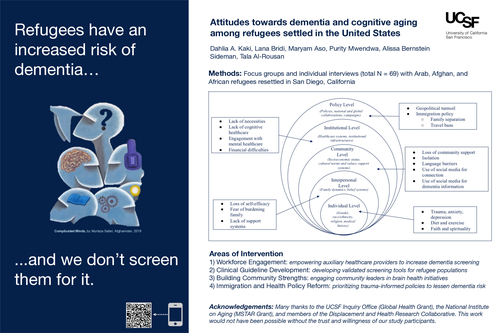
Methods: We conducted focus groups and individual interviews (total N = 69) with Arab, Afghan, and African refugees resettled in San Diego, the second-largest resettlement city in the US. Participants were interviewed using in-depth, semi-structured interviews. Data was transcribed, translated, and coded using inductive thematic analysis.
Results: Participant knowledge on dementia and access to cognitive healthcare were organized using the socioecological model of health. Individually, participants believed stress, traumatic experiences, and mental ill-health resultant from their migration history increased their personal risk of dementia. Interpersonally, they expressed fear of dementia due to concerns of burdening loved ones and lacking the social support system to be properly cared for. Many relied on their community, including social media networks, for information about dementia and, overwhelmingly, participants expressed the loss of community as a source of stress contributing to their risk of dementia. They reported challenges with healthcare institutions throughout their migration journey, both in refugee camps in the US; notably, healthcare providers across the board did not address cognitive health concerns. Finally, participants reported frustrations with immigration and healthcare policies as general barriers to healthy physical and cognitive aging.
Discussion: Refugees have a robust understanding of dementia and their personal risk factors for pathologic cognitive aging. Clinician training and workforce capacity building is needed to ensure this population has proper screening and engagement with cognitive healthcare services. Finally, we must address refugee mental health and social support concerns to mitigate dementia risk and support healthy aging.