145 posters, 12 topics, 25 sessions, 145 authors
ePostersLive by SciGen Technologies S.A. All rights reserved.
UCSF 2023 Inquiry Symposium
10 May | University of San Francisco

P116
Disparities in Advance Care Planning Rates Persist Among Emergency General Surgery Patients
Poster Presenter
Authors
Part of Topic
Systems Science
Introduction:
Unanticipated changes in health status and acute changes in chronic conditions often prompt the need to consider EGS. Discussions with patients about their goals of care improve patient-clinician understanding and trust and reduce patient and caregiver depression and anxiety; however, these conversations and standardized documentation of such remain infrequent for EGS patients.
Hypothesis:
We hypothesized that patient, clinician, medical and/or surgical conditions, and hospital course influence prevalence of ACP completion.
Aims
We sought to better understand advanced care planning (ACP) practices in emergency general surgery (EGS) care and to describe the prevalence of ACP documentation.
Project Design/Methods:
We conducted a retrospective cohort study using electronic health record (EHR) data from patients admitted to an EGS service at a tertiary academic center to determine the prevalence of clinically meaningful ACP documentation (conversations and legal ACP forms) during the EGS hospitalization. Multivariable regression was performed to identify patient, clinician, and procedural factors associated with the lack of ACP.
Results:
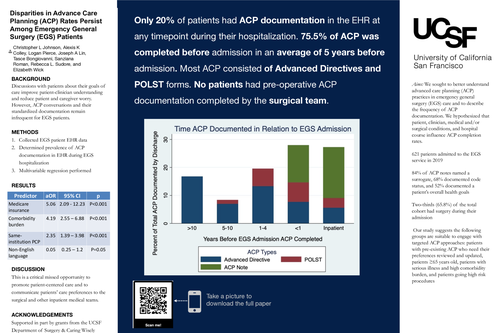
Among 621 patients admitted to the EGS service in 2019, only 20.1% had ACP documentation in the EHR at any timepoint during their hospitalization. Of those, 75.5% were completed before admission. Pre-admission ACP was completed an average of 5 years before admission and consisted of scanned documents (advanced directives 61.1%, POLST forms 19.5%,) and clinician-generated ACP notes written directly into the EHR. Post-admission ACP tended to be completed by the internal medicine team, with 84% of ACP notes naming a surrogate, 68% documenting code status, and 52% documenting a patient’s overall health goals. Two-thirds (65.8%) of the total cohort had surgery during their admission; none of them had a documentation of an ACP conversation with the surgical team preoperatively. Patients with ACP documentation were likely to have Medicare insurance (aOR 5.06, 95% CI 2.09 – 12.23, p<0.001), experience a greater burden of comorbid conditions (aOR 4.19, 95% CI 2.55 – 6.88, p<0.001), and receive primary care at the same institution were EGS management occurred (aOR 2.35, 95% CI 1.39 –3.98, p<0.001). Patients who did not speak English as a preferred language had lower odds of having ACP documentation (aOR 0.50, 95% CI 0.25 – 1.2, p=0.05).
Discussion:
Adults experiencing a significant, often abrupt change in health status leading to an EGS admission are infrequently engaged in ACP conducted by the surgical team. When it was documented, ACP was often out of date and not documented by the surgical team, raising concerns about the capacity of pre-existing ACP to inform decision-making during an acute surgical admission. This is a critical missed opportunity to promote patient-centered care and to communicate patients’ care preferences to the surgical and other inpatient medical teams. Our study suggests the following groups are suitable to engage with targeted ACP approaches: patients with pre-existing ACP who need their preferences reviewed and updated, patients ≥65 years old, patients with serious illness and high comorbidity burden, and patients undergoing high risk procedures.