145 posters, 12 topics, 25 sessions, 145 authors
ePostersLive by SciGen Technologies S.A. All rights reserved.
UCSF 2023 Inquiry Symposium
10 May | University of San Francisco

P115
Defining immune cell trajectories between blood and skin in psoriasis
Part of Topic
Biomedical Science
Introduction: Psoriasis is a chronic, immune-mediated skin disorder that affects 3% of
the U.S. In addition to lifelong flares of skin lesions, approximately 30% of patients are
co-diagnosed with psoriatic arthritis, and all patients are at increased risk for systemic
comorbidities such as cardiovascular disease, inflammatory bowel disease, and
depression. While several biologic immunotherapies exist, with IL-17 being a key
cytokine target, there is a sizeable subset of patients who do not experience clinical
relief with these treatments. Defining how skin tissue impacts immune cell function and
whether certain T cell clonotypes/subsets traffic from the blood to skin (and vice versa)
is critical to understanding how psoriasis develops and flares following remission
periods. However, the differences and relationships between blood and skin immune
populations that drive psoriatic disease are not well investigated, as most prior studies
have only profiled immune cells in the skin.
Hypothesis: New research techniques, including single-cell RNA sequencing (scRNA-
seq), allow us to study psoriasis pathogenesis in greater detail and systematically
search the types of cells, interactions, and developmental trajectories of individual cells
moving between blood and skin. We hypothesize that T cell clonotypes present in the
blood drive peripheral disease, and that scRNA-seq will uncover cell subpopulations
and individual genes that may serve as potential therapeutic targets for further study.
Aims: The goals of my project are to: (1) define the immunocytes in blood and skin
samples unique to psoriasis patients, (2) identify ligand-receptor interactions between
different cell types, and (3) learn how immunocytes from peripheral blood, non-lesional
skin, and lesional skin are developmentally related in psoriasis.
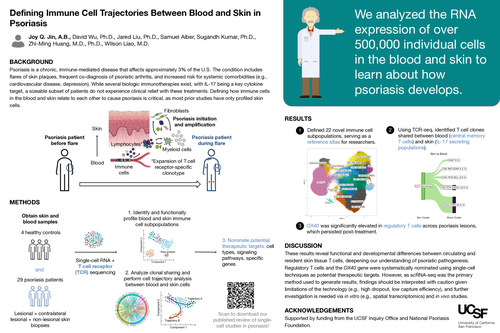
Project Design: Skin biopsies (lesional, contralateral lesional, non-lesional) and
peripheral blood samples were obtained from 4 healthy patients and 29 plaque psoriasis
patients before and after treatment. ScRNA-seq and T cell receptor sequencing (TCR-
seq) were performed on these samples, generating a large dataset of 500,000+ cells
with RNA expression levels noted within each cell. Computational analyses were then
performed to: (1) identify and functionally profile (using differential gene expression and
signaling pathway analyses) blood and skin immune cell subpopulations, and (2)
analyze clonal sharing and perform cell trajectory analysis (RNA velocity) to determine
transition states between blood and skin cells.
Results: Our results included three key takeaways. First, 22 novel immune cell
subpopulations were defined using the BioTuring neural network and known signature
markers reported in the literature, serving as a reference atlas for researchers in the
field. Second, using TCR-seq, IL-17 secreting populations in the skin were found to
share a clonal lineage with central memory T cells in the blood. Finally, the OX40 gene
was significantly elevated in regulatory T cells, which persisted post-treatment across
psoriasis patients.Discussion: These results reveal functional and developmental differences between
circulating and resident skin tissue T cells, deepening our understanding of psoriatic
pathogenesis. Regulatory T cells and the OX40 gene were systematically nominated
using single-cell techniques as potential therapeutic targets. However, as scRNA-seq
was the primary method used to generate results, findings should be interpreted with
caution given limitations of the technology (e.g., high dropout, low capture efficiency),
and further investigation is needed via in vitro (e.g., spatial transcriptomics) and in vivo
studies.