145 posters, 12 topics, 25 sessions, 145 authors
ePostersLive by SciGen Technologies S.A. All rights reserved.
UCSF 2023 Inquiry Symposium
10 May | University of San Francisco

P114
Financial Toxicity in Dementia Caregiving
Poster Presenter
Authors
Part of Topic
Social & Behavioral
Introduction
Recent work has documented dementia caregivers often incur serious financial costs. However, the psychological burdens associated with these costs have not been well studied. The term “financial toxicity” has been used in many care settings to describe the negative effects of medical expenses on both financial security and health-related quality of life. Here, we utilize the validated COmprehensive Score for financial Toxicity (COST) to examine the experience of financial toxicity in American dementia caregiving.
Hypothesis
We hypothesized a majority of caregivers would experience financial toxicity, with lower income and unemployed caregivers particularly at risk. We also expected a correlation between financial toxicity and dementia stage, with higher instance of financial toxicity earlier on, when costs of care are uncertain, or towards the end of disease progression, when costs of care are greater.
Aims
(1) Assess sociodemographic and clinical correlates of financial toxicity in dementia caregiving.
Methods
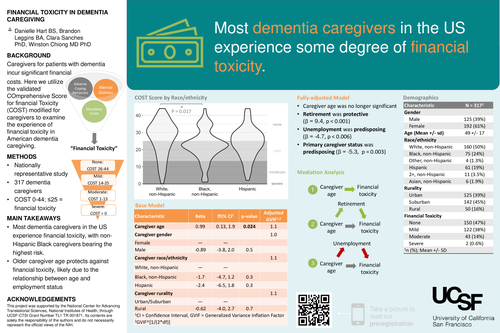
We conducted a nationally representative survey of 317 US dementia caregivers, oversampling non-Hispanic Black (n = 75) and Hispanic (n = 61) caregivers, with the COST questionnaire. Financial toxicity was defined as COST score <26 and further categorized as mild (COST ≥14 & <26), moderate (COST >0 & <14), or severe (COST = 0) according to the measure’s predetermined cut points. COST was treated categorically to generate descriptive statistics and continuously for linear regression. We built nested multivariable models to use in our regression-based analysis. The base model included key caregiver demographics (age, gender, race/ethnicity, rurality), to which the fully adjusted model added supplementary caregiver demographics (education, income, employment status), care recipient clinical characteristics (age, gender, race/ethnicity, rurality, dementia diagnosis, dementia stage, primary condition), and caregiver-recipient relational characteristics (relationship to caregiver, care recipient residence, primary caregiver status, visit frequency). Mediation analysis was performed to further characterize the relationship between correlates.
Results/Product
Survey-weighted categorical analysis revealed 52.7% of American caregivers experience some degree of financial toxicity. Of those who experience financial toxicity, 73.1% are classified as mild, 25.7% as moderate, and 1.2% as severe. Financial toxicity was identified in 69.5% of non-Hispanic Black, 54.1% of Hispanic, and 42.3% of non-Hispanic White caregivers, with non-Hispanic Black caregivers significantly more likely to experience financial toxicity compared to non-Hispanic White caregivers (p = 0.017). In our base linear regression model, older caregiver age was protective against financial toxicity (p = 0.024). Caregiver employment status mediated this effect in the fully adjusted model, with retirement protective against financial toxicity (p <0.001) and unemployment predisposing to financial toxicity (p = 0.006). Primary caregiver status also predisposed caregivers to financial toxicity (p = 0.003).
Discussion/Conclusion
As we expected, most dementia caregivers in the US experience financial toxicity. Of all racial/ethnic groups, non-Hispanic Black caregivers bear the highest risk. This is congruent with the current financial toxicity literature, as studies in other clinical contexts have identified similar racial disparities. Older caregiver age protects against financial toxicity, likely due to the relationship between age and employment status. Interestingly, disease severity was not a significant correlate as we originally hypothesized, suggesting caregivers experience financial toxicity at every stage of their loved one’s dementia. The limitations of this study largely stem from its methodology, as this is a survey-based experiment (eg response bias, non-response bias). While more work in needed to reproduce and improve upon this pioneer study, our findings highlight the need for interventions and policy change to better support this population.