145 posters, 12 topics, 25 sessions, 145 authors
ePostersLive by SciGen Technologies S.A. All rights reserved.
UCSF 2023 Inquiry Symposium
10 May | University of San Francisco

P112
The role of TNF in a high fat diet stroke model and the influence on inflammation, stroke size and functional outcome
Poster Presenter
Part of Topic
Biomedical Science
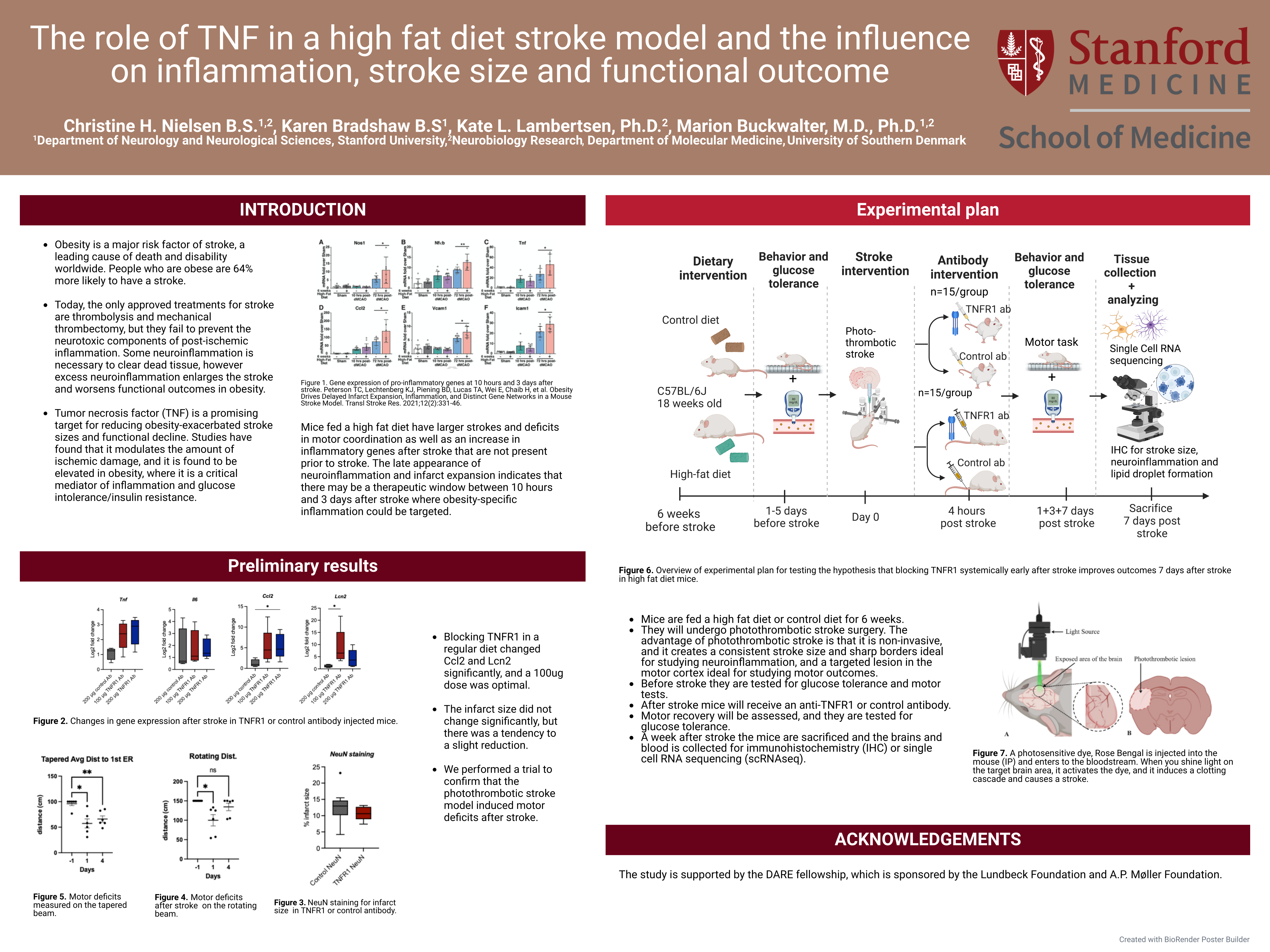
INTRODUCTION. Obesity is a major risk factor of stroke, a leading cause of death and disability worldwide. People who are obese are 64% more likely to have a stroke. Mice fed a high fat diet have larger strokes and deficits in motor coordination. The late appearance of neuroinflammation and infarct expansion indicates that there may be a therapeutic window between 10 hours and 3 days after stroke where obesity-specific inflammation could be targeted to improve outcomes in obese stroke patients.
HYPOTHESIS. We will test the hypothesis that blocking TNFR1 systemically early after stroke improves outcomes 7 days after stroke in high fat diet mice.
AIM. Determine whether blocking TNFR1 will reduce infarct size, inflammation and improve motor function by affecting the peripheral (body) or central (brain) immune response.
METHODS. Mice are fed a high fat diet or control diet for 6 weeks. They will undergo photothrombotic stroke surgery. The advantage of photothrombotic stroke is that it is non-invasive, and it creates a consistent stroke size and sharp borders ideal for studying neuroinflammation, and a targeted lesion in the motor cortex ideal for studying motor outcomes. Before stroke they are tested for glucose tolerance and motor tests. After stroke mice will receive an anti-TNFR1 or control antibody. Motor recovery will be assessed, and they are tested for glucose tolerance. A week after stroke the mice are sacrificed and the brains and blood is collected for immunohistochemistry (IHC) or single cell RNA sequencing (scRNAseq).
PRELIMINARY RESULTS. The Buckwalter and Lambertsen labs have promising preliminary data that displays upregulation of TNF, TNFR1, and TNFR2 up to 10 days after normal diet stroke. They also found that mice fed a high-fat diet display increased stroke sizes, neuroinflammation and glucose intolerance, and increased expression of TNF and its receptors between 10 hours and 3 days, pointing to an early therapeutic window in which we may ameliorate obesity-exacerbated neuroinflammation by affecting the TNFR1 signaling pathway. When I tested if blocking TNFR1 in a regular diet would change the RNA levels of TNFR1 downstream genes, I found that Ccl2 and Lcn2 was significantly increased. When testing for the right dose, I found that a 100ug dose was optimal. Infarct size did not change. The photothrombotic stroke model induced motor deficits in the mice after stroke tested on the tapered beam and rotating beam.
DISCUSSION/CONCLUSSION: My findings are similar to what others have found, and they have also found improvements in behavioral outcomes and metabolic alterations, which could indicate that I would find this as well in my experiment currently running, where I am testing the effects of the TNFR1 antibody in the high fat diet stroke model. Though the field has found that TNF is involved in stroke and obesity, respectively, it is unclear if and how TNF is involved in obesity-exacerbated stroke outcomes. This study will be the first to establish the effect of TNF in obesity-exacerbated stroke outcomes and to establish the mechanism of its effect in regular weight as well as obese mice. If the study confirms that inhibiting TNFR1 expression ameliorates stroke outcomes in the obesity-model, this study will establish that TNF is a driver of obesity-exacerbated stroke outcomes characterized by inflammation, glucose intolerance, motor function, and stroke size.