145 posters, 12 topics, 25 sessions, 145 authors
ePostersLive by SciGen Technologies S.A. All rights reserved.
UCSF 2023 Inquiry Symposium
10 May | University of San Francisco

P109
A post-outbreak assessment of exposure proximity and Ebola virus disease-related stigma among community members in Kono District, Sierra Leone: A cross-sectional study
Poster Presenter
Authors
Part of Topic
Social & Behavioral
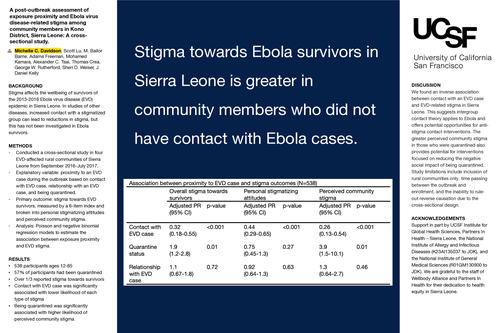
Introduction: The 2013–2016 Ebola virus disease (EVD) epidemic in West Africa was the largest in history, introducing lasting impacts on survivors and communities. While it is widely recognized that stigma existed towards EVD survivors in Sierra Leone during the outbreak, comprehensive measurements of personal and perceived EVD-related stigma are limited. Expanding upon these measurements and implementing evidence-based stigma-reduction interventions provide an opportunity to improve the well-being of survivors and their communities. Intergroup contact theory posits that greater contact with someone belonging to a stigmatized group, under certain conditions, is associated with reduced levels of prejudice and may influence disease-related stigma. This has been demonstrated through studies on stigma towards people living with HIV and people with mental health conditions but has not been investigated in Ebola survivors. Hypothesis: Based on findings from other contexts, informed by intergroup contact theory that more contact is associated with less stigma, we hypothesized that community members with greater exposure to cases of EVD were less likely to report EVD-related stigma towards EVD survivors. Aims: 1) To assess personal stigmatizing attitudes towards Ebola survivors, which reflects personal fear and judgement, and perceived stigma towards EVD survivors, which reflects an individual’s perception of the attitudes of the community towards a stigmatized group. 2) To assess how these attitudes related to proximity to an EVD case, based on having contact with an EVD case, being quarantined during the outbreak, or having a relationship with an EVD case. 3) To encourage discussion of anti-stigma interventions in communities affected by EVD. Methods: From September 2016 to July 2017, we conducted a cross-sectional, community-based study of EVD-related stigma among individuals who did not contract Ebola in four EVD-affected rural communities of Kono District, Sierra Leone. We identified individuals from all quarantined households and obtained a random sample of those who were unexposed. Exposed individuals either lived in a quarantined household or were reported to have been in contact with an EVD case. Our explanatory variable was proximity to an EVD case during the outbreak. Our primary outcome was stigma towards EVD survivors, measured by a 6-item adapted HIVrelated stigma index validated in Zambia and South Africa, with 1 item reflecting personal stigmatizing attitudes and 5 items reflecting perceived community stigma. The 6-item EVD stigma index had good internal consistency (Cronbach's alpha 0.82). We used modified Poisson and negative binomial regression models, adjusting for potential confounders, to estimate the association between exposure proximity and EVD stigma. Results: We interviewed 538 participants aged 12 to 85 years. Most (57%) had been quarantined. Over one-third (39%) reported personal stigmatizing attitudes or perceived community stigma; the most frequently endorsed item was fear and judgment towards EVD survivors. Having contact with someone with EVD was significantly associated with a lower likelihood of perceived community stigma (prevalence ratio [PR], 0.26; 95% CI, 0.13–0.54) and personal stigmatizing attitudes (PR, 0.44; 95% CI, 0.29–0.65). In contrast, being quarantined was significantly associated with a higher likelihood of perceived community stigma (PR, 3.9; 95% CI, 1.5–10.1) Discussion: In communities heavily affected by the 2013–2016 EVD epidemic in Sierra Leone, we found evidence of an inverse association between EVD-related stigma and contact with an EVD case, substantiating the role of intergroup contact theory in this context. There was a higher perception of community stigma in those who were quarantined and greater stigmatizing attitudes in those without contact with an EVD case. The greater perceived stigma in those who were quarantined suggests that those who identify more closely with the survivors may be more likely to perceive stigma from the community at large. The increase in stigmatizing attitudes towards survivors in those without contact with EVD cases offers a potential target for anti-stigma interventions. Contact interventions create an environment where the community can interact with a stigmatized group, either directly or through the media, thereby increasing familiarity and decreasing stigma. One possible approach to reducing EVD-related stigma is involving survivors in implementing anti-stigma interventions, which can help survivors regain livelihood, reduce stigma, and provide opportunities for inclusion as trusted community members aiding in Ebola prevention and response. Limitations of the study include the rapid adaptation of the stigma measurement from a validated tool during a humanitarian crisis, inclusion of rural communities only, time passing between the EVD outbreak and enrollment of participants, the inability to rule out reverse causation in the observed relationship between contact and EVD-related stigma due to the cross-sectional design, and the potential for unmeasured, unknown confounders.