145 posters, 12 topics, 25 sessions, 145 authors
ePostersLive by SciGen Technologies S.A. All rights reserved.
UCSF 2023 Inquiry Symposium
10 May | University of San Francisco

P108
A social needs screening tool facilitates reduced length of stay and total encounter cost for surgical patients
Poster Presenter
Authors
Part of Topic
Systems Science
Background:
Prolonged length of stay (LOS) after surgery has been shown to worsen patient recovery and utilize health system resources unnecessarily. Logistical and social support barriers to optimizing surgical care have been under-examined. The primary objective of this study was to implement a social needs screening tool amongst patients undergoing urologic surgical care and measure its impact on length of stay and total direct cost.
Methods:
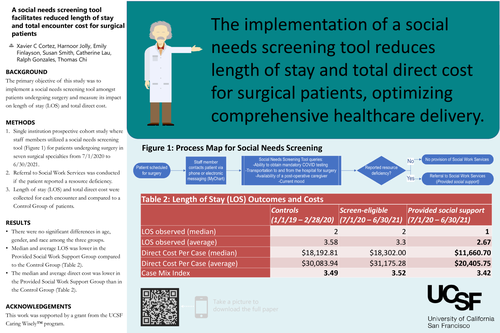
This was a single institution prospective cohort study where a social needs screening tool was applied to patients undergoing elective surgery in seven surgical departments (Urology, Ophthalmology, OHNS, Vascular, Neurosurgery, Orthopedics, and Plastics) from July 1, 2020 to June 30, 2021. Social needs screening was conducted by a staff member via phone or electronic messaging after surgery was scheduled. Patient ability to obtain mandatory COVID testing, transportation to and from the hospital for surgery, availability of a post-operative caregiver, and current mood were queried during screening. Referral to Social Work Services was conducted if the patient reported a resource deficiency. LOS and total direct cost were collected for each encounter and compared to a historical control cohort of patients from the same departments from January 1, 2019 to February 28, 2020 that did not undergo social needs screening.
Results:
3284 patients were screen-eligible during the study period and were compared to 3360 control encounters. Of the screened patients, 190 screened positive and were provided social work support. There were no significant differences in age, gender, and race between the screened and control cohorts. Screen-positive patients were more likely to reside in a county outside of the greater San Francisco Bay Area and more likely to have government insurance as their primary payor (p < 0.05). Median and average LOS was lower in the intervention (1, 2.67 days) compared to the control cohort (2, 3.58 days). Median and average direct cost was lower in the intervention ($11,661; $20,406) compared to the control ($18,193; $30,084) cohort.
Conclusion:
The implementation of a social needs screening tool to proactively address logistical barriers to care reduces LOS and total direct cost for surgical patients, optimizing comprehensive healthcare delivery.