145 posters, 12 topics, 25 sessions, 145 authors
ePostersLive by SciGen Technologies S.A. All rights reserved.
UCSF 2023 Inquiry Symposium
10 May | University of San Francisco

P104
Modulation of the PPARg pathway to augment NECTIN4 expression and sensitivity to NECTIN4 targeting therapies in bladder cancer
Poster Presenter
Authors
Part of Topic
Biomedical Science
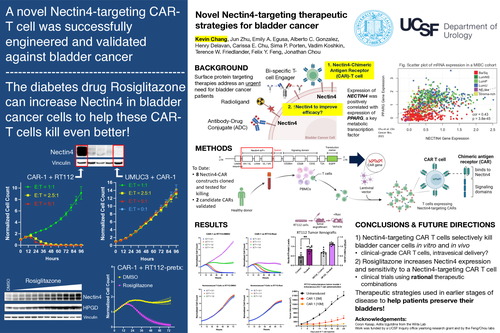
BACKGROUND: Urothelial carcinoma (UC) of the bladder is the 6th most common cancer in the US, and patients who develop metastatic UC (mUC) have a 5-year survival of under 5%. Therefore, additional strategies to target mUC are urgently needed. Surface protein targeting therapeutics, including include antibody-drug conjugates (ADCs), chimeric antigen receptor (CAR) T cells, radioligand therapies and bispecific T cell engagers, hold great promise for cancer treatment. Recently, the FDA approved enfortumab vedotin (EV), the first ADC targeting NECTIN4. However, the mechanisms controlling NECTIN4 expression, a critical mediator of sensitivity and resistance to NECTIN4-targeting therapeutics, are unknown. Previous data from the lab showed that inducing NECTIN4 in tumor cells with low or medium levels improves tumor targeting, and that NECTIN4 expression is associated with expression of the nuclear receptor peroxisome proliferator-activated receptor g (PPARg), whose activity can be modulated by directly binding fatty acids and other small molecules.
RESEARCH QUESTION: We hypothesize that the PPARg pathway is a key mediator controlling NECTIN4 expression, and that pharmacologic manipulation of the PPARg pathway can augment sensitivity to EV and other NECTIN4-targeting therapies.
METHODS: RT112 bladder cancer cells were treated with PPARg agonists (rosiglitazone) and antagonists (T0070907) and assessed for NECTIN4 mRNA expression and protein expression using quantitative PCR and western blot. siRNA- and CRISPR/Cas9 were used to investigate the effects of decreasing PPARG on NECTIN4 expression. RT112 cells were xenografted into mice, which were treated with either vehicle or rosiglitazone and tumors were assayed for NECTIN4 using immunohistochemistry. Cell lines treated with rosiglitazone followed by EV dose-response assays. NECTIN4-targeting chimeric antigen receptor (CAR) constructs were designed and cloned into a CAR backbone including the CD28 costimulatory domain. Human primary T cells were transduced with lentiviral CAR constructs and screened for killing activity against bladder cancer cells and used in CAR-T killing assays against bladder cancer cells pre-treated with rosiglitazone.
RESULTS: PPARg agonists and antagonists upregulate and downregulate NECTIN4 mRNA and protein expression, respectively. Loss of PPARG inhibits NECTIN4. Upregulating the PPARg pathway using rosiglitazone induced Nectin4 expression 4-fold in bladder cancer cell lines and in xenografted tumors. Rosiglitazone increased the sensitivity to EV in vitro, and decreased the IC50 by 50%. Two candidate NECTIN4-CAR constructs were generated and validated for on-target killing. Rosiglitazone pretreatment enhanced Nectin4-CAR-T killing efficacy against Nectin4-expressing bladder cancer cells by 3-fold in co-culture assays in vitro. Preliminary data shows efficacy of NECTIN4-CAR-T cells in mice bearing xenografted tumors.
CONCLUSIONS: PPARG is necessary for NECTIN4 expression. Treating bladder cancer cells with rosiglitazone, a PPARg agonist used in diabetes, increases NECTIN4 expression and augments the efficacy of NECTIN4-targeting therapies, including EV and NECTIN4-CAR-T cells. Moreover, we demonstrate encouraging in vitro and in vivo antitumor activity using our novel NECTIN4 CAR T cells. These preclinical results lay the groundwork for future clinical trials of novel drug combinations that will improve the effectiveness NECTIN4-targeting therapies and offset treatment disparities due to heterogeneity in tumor expression of NECTIN4. Finally, this work may have implications beyond bladder cancer, informing therapeutic strategies in other NECTIN4-expressing cancers, including breast, ovarian, lung and pancreatic cancer.