145 posters, 12 topics, 25 sessions, 145 authors
ePostersLive by SciGen Technologies S.A. All rights reserved.
UCSF 2023 Inquiry Symposium
10 May | University of San Francisco

P103
Immune Depletion in Bevacizumab-treated Glioblastoma
Poster Presenter
Authors
Part of Topic
Biomedical Science
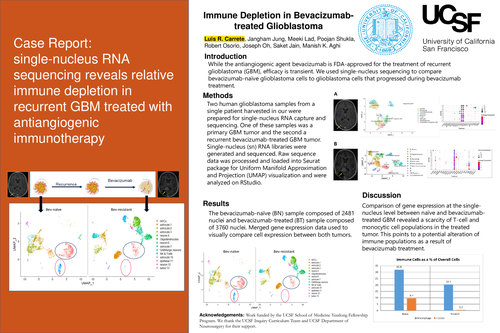
INTRODUCTION Glioblastoma (GBM) is the most common and most aggressive primary brain tumor with limited response to surgery and chemoradiation. GBM is highly lethal with a median survival after surgery and chemoradiation of 12-15 months and a 5-year survival rate under 5%. While the antiangiogenic agent bevacizumab is the only FDA-approved agent for the treatment of recurrent glioblastoma, efficacy is transient. Phase III clinical trials of bevacizumab in recurrent GBM demonstrated that while there was increased freedom from tumor progression, there was no change in patient overall survival. There is a paucity of data characterizing bevacizumabtreated GBM utilizing scRNAseq data, and there has yet to be a study to assess human GBM tumors before and after bevacizumab therapy through snRNAseq. HYPOTHESIS: We hypothesize that by comparing tumor samples from a single patient at the single-nucleus level before and after bevacizumab treatment will reveal responses to tumor cell populations to antiangiogenic immunotherapy. AIM: Characterize and compare banked paired samples from at the single-nucleus level from a single patient who underwent tumor resection before and after bevacizumab treatment. The utilization of single-nucleus sequencing to compare bevacizumab-naïve glioblastoma cells to glioblastoma cells that progressed during bevacizumab treatment will reveal differences in cell populations that will help us understand cell-cell interactions and intrinsic processes driving bevacizumab-induced resistance in GBM to develop effective therapies that prevent this resistance in a manner that unlocks the therapeutic potential of bevacizumab. METHODS A retrospective study of patients who underwent primary glioblastoma resection at our institution between 2010-2020 was approved by the UCSF Internal Review Board (IRB Number: 11-06160) and subsequently performed. Among an initial sample of 623 patients, 353 were treated with bevacizumab at the time of recurrence. We further selected cases where patients progressed following a complete cycle of bevacizumab treatment. We then selected for cases where the recurrent tumor was 60 days of stopping bevacizumab therapy. After selecting for these cases, only two human glioblastoma samples from a single patient were obtained and prepared for single-nucleus RNA capture and sequencing. One of these samples was a primary tumor and the second a recurrent bevacizumab-treated tumors. Single-nucleus (sn) RNA libraries were generated and sequenced. Raw sequence data was processed and loaded into Seurat package for Uniform Manifold Approximation and Projection (UMAP) visualization and were analyzed on RStudio. RESULTS This is the case of a 49 year-old man who presented to our institution with headaches and visual symptoms. MRI demonstrated a hyperintense right-occipital lesion on T1 post-contrast MR imaging. Subsequently the patient underwent gross total resection of the lesion followed by chemoradiation. The tumor confirmed to be GBM through pathological analysis. Two years later, the patient was found to have a recurrent lesion, and was treated with a full cycle of bevacizumab immunotherapy. Given ongoing tumor progression under bevacizumab treatment, the tumor was resected less than 50 days after the cessation of bevacizumab therapy. In both instances, following tumor resection, samples of the resected tumors were frozen and stored at the UCSF BTC. snRNA-seq Analysis of Gene Expression Reveals Relative Immune Depletion in Recurrent Bevacizumab-Treated Tumor. Gene-expression profiles of the paired patient samples were assessed separately, and subsequently in combination to assess relative differences in gene expression corresponding to specific cell nucleus populations. The bevacizumab-naïve (BN) sample was composed of 2481 nuclei and bevacizumab-treated (BT) sample was composed of 3760 nuclei. Pooled together, this tumor pair was composed of a nucleus population of 6241 containing 9.4% vs 0.2% T-cells and 31.8% vs 6.8% monocytes in the pre-treatment group relative to post-treatment group, respectively. DISCUSSION This is the first study of its kind to utilize snRNA-seq to follow the GBM profile of a single patient from the point of initial tumor resection to the point of repeat resection after chemoradiation, recurrence, and immunotherapy with bevacizumab. Our findings suggest that there could be a considerable degree of depletion of T-cells and monocytes in GBM following recurrence and treatment with bevacizumab. Given the highly adaptive nature of GBM, it is possible that the resistant GBM profile following treatment with bevacizumab resulted in a tumor phenotype that promoted a greater degree of immunosuppression. Recently-published work suggests that the immune profile of a recurrent GBM can vary considerably between patients with T-cell expression ranging from as high as ~8% of the overall tumor population to <1%. Thus, the immunosuppressive role of bevacizumab our recurrent tumor sample is difficult to ascertain. Limitations. The proportion of cells represented by the data in a given tumor can be altered based on the utilization of scRNA-seq or snRNA-seq. Prior literature on neuroblastoma and metastatic breast cancer where a single tumor was analyzed with each of the two techniques, the proportion of T-cells was considerably diminished under the snRNA-seq technique relative to scRNA-seq. Monocyte expression as a proportion of entire tumor cells remained relatively unchanged between techniques. While the same comparison has not published for GBM, it must the possible under-estimation of T-cell expression under snRNA-seq analyses must be stated. It is also important to note that additional tumor pairs are required to attempt to corroborate our current findings. There is no question that our conclusions are limited by our single-patient pair. Future Directions. Confirmatory studies to support our initial findings are underway. Two additional tumor pairs are being prepared for snRNA-seq. Also, given the potential limitation of alteration of T-cell proportions through processing for snRNA-seq, we are also in the process of sequencing bevacizumab-treated GBM samples through scRNA-seq. We are also conducting in vivo experiment in which we implant GL261 GBM cells intracranially to immune-competent mice and assess the alterations of the tumor immune population following bevacizumab treatment. The immune populations of these tumors are then assessed through flow cytometry and additional down-stream analyses. Conclusion. This study is the first of its kind in comparing primary to recurrent bevacizumabtreated GBM acquired from a single patient. The relative immune depletion in the form of diminished T-cell and monocyte populations will be a key factor to study further with additional samples from the operating room as well as through animal in vivo studies.