2,281 posters, 63 videos, 56 audios, 43 topics, 18 sessions, 6,174 authors, 2,323 institutions
ePostersLive by SciGen Technologies S.A. All rights reserved.
RCOG World Congress 2025
June 23 - 25, 2025 | ExCeL London, UK
PP.0049
Cost Savings in Postpartum Hemorrhage Management: Impact of Reduced Device Indwelling Time
Poster Presenter
Part of Topic
Intrapartum care
1. BACKGROUND & OBJECTIVES:
•Postpartum hemorrhage (PPH) is a serious and potentially life-threatening complication of childbirth, accounting for 12% of maternal fatalities in the United States (US) between 2017 and 2019.¹
•In addition to the clinical implications for patients, PPH imposes a substantial financial strain on the healthcare system, with related costs in the US estimated at $1.8 billion in 2019.²
•Clinical practice guidelines recommend a stepwise escalation in the management of PPH, beginning with uterotonics and advancing to interventions like balloon tamponade and, if necessary, surgical procedures including hysterectomy.³
•A new intrauterine vacuum-induced hemorrhage control (VIHC) device controls hemorrhage via vacuum, offering an alternative to balloon tamponade. A key advantage of this device is its significantly reduced indwelling time, defined as the time from when the device is inserted to when it is removed. Published real-word evidence shows the use of such devices translate to reductions in staffing time and resource use.
2. DESIGN:
•This study evaluated the role of reduced indwelling time in achieving cost savings and improved resource utilization in PPH management.
•A budget impact model (BIM) was developed from the US hospital perspective with a 1-year time horizon.
•The BIM estimated the cost savings associated with reduced device indwelling time and improved resource utilization when using the intrauterine VIHC compared to balloon tamponade for PPH management.
3. METHODS:
•The population aligned with the PEARLE study and included females with abnormal bleeding/PPH that required at least one uterotonic (beyond oxytocin).4
•The inputs comprised hospital resource utilization, epidemiology, treatment adoption, efficacy, and cost factors. Resource use and cost data were primarily obtained from the PINC AI™ Healthcare Database (PHD), with additional inputs sourced from the RUBY study.5 Specifically, the input for device indwelling time for the intrauterine VIHC device and balloon tamponade were 3.1 and 18.0 hours respectively.
•The unit costs for each resource use were sourced from the PHD data, current procedural terminology, and diagnostic delated group codes.
•The costs for device indwelling time were based on per hour cost in labour and delivery rooms.
4. RESULTS:
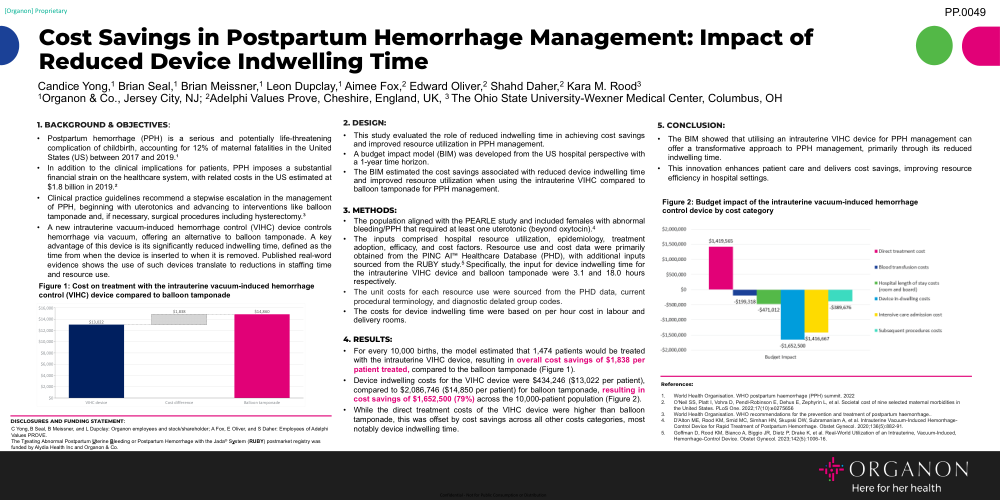
•For every 10,000 births, the model estimated that 1,474 patients would be treated with the intrauterine VIHC device, resulting in overall cost savings of $1,838 per patient treated, compared to the balloon tamponade (Figure 1).
•Device indwelling costs for the VIHC device were $434,246 ($13,022 per patient), compared to $2,086,746 ($14,850 per patient) for balloon tamponade, resulting in cost savings of $1,652,500 (79%) across the 10,000-patient population (Figure 2).
•While the direct treatment costs of the VIHC device were higher than balloon tamponade, this was offset by cost savings across all other costs categories, most notably device indwelling time.
5. CONCLUSION:
•The BIM showed that utilising an intrauterine VIHC device for PPH management can offer a transformative approach to PPH management, primarily through its reduced indwelling time.
•This innovation enhances patient care and delivers cost savings, improving resource efficiency in hospital settings.