2,281 posters, 63 videos, 56 audios, 43 topics, 18 sessions, 6,174 authors, 2,323 institutions
ePostersLive by SciGen Technologies S.A. All rights reserved.
RCOG World Congress 2025
June 23 - 25, 2025 | ExCeL London, UK
EP.1341
External validation of the ECSIL model for predicting caesarean delivery after IOL
Poster Presenter
Part of Topic
Intrapartum care
External Validation of the Clinical Prediction Model (ECSIL) for Caesarean Delivery After Induction of Labour in Singleton Pregnancies at Term Gestation
Garima Yadav, Anjana Mathur, Manisha Dorwal, Meenakshi Gothwal, Priyanka Khaturia, Pratibha Singh
Department of Obstetrics and Gynecology, All India Institute of Medical Sciences (AIIMS), Jodhpur, India
Background
The caesarean section (CS) rate in India has increased from 3% in 1992–93 to 21.5% in 2019–21¹. With rising CS rates following induction of labour (IOL), personalised risk prediction is crucial to reduce unnecessary interventions and improve outcomes. Although several predictive models exist, few have been externally validated across diverse populations2-3.
The ECSIL model, based on maternal demographics, medical history, and cervical examination, aims to predict the likelihood of CS.
Objective
-
Design: Prospective observational study
-
Setting: AIIMS Jodhpur
-
Duration: July 2023 – March 2024
-
Inclusion Criteria: Term (37–42 weeks), singleton pregnancies with cephalic presentation and unfavourable cervix (Bishop score ≤6), undergoing IOL for medical/obstetric indications
-
Exclusion Criteria: Favourable cervix (Bishop score >6), multifetal gestation, uterine scar, malpresentation, abnormal placentation, distorted pelvis, infections, malignancy, fetal demise, hypersensitivity to dinoprostone, hydrocephalus, and non-reassuring fetal status at IOL initiation.
-
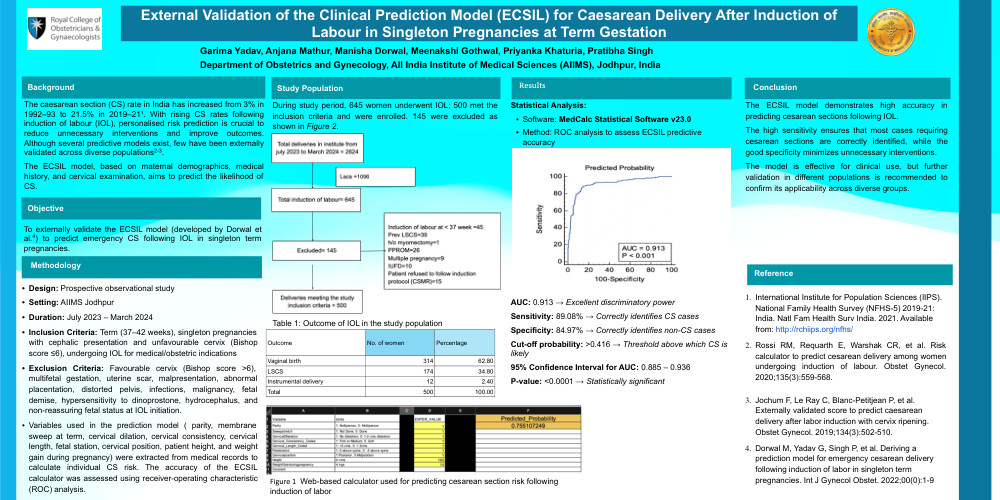
Variables used in the prediction model ( parity, membrane sweep at term, cervical dilation, cervical consistency, cervical length, fetal station, cervical position, patient height, and weight gain during pregnancy) were extracted from medical records to calculate individual CS risk. The accuracy of the ECSIL calculator was assessed using receiver-operating characteristic (ROC) analysis.
Statistical Analysis:
-
Software: MedCalc Statistical Software v23.0
-
Method: ROC analysis to assess ECSIL predictive accuracy
AUC: 0.913 → Excellent discriminatory power
Sensitivity: 89.08% → Correctly identifies CS cases
Specificity: 84.97% → Correctly identifies non-CS cases
Cut-off probability: >0.416 → Threshold above which CS is likely
95% Confidence Interval for AUC: 0.885 – 0.936
P-value: <0.0001 → Statistically significantThe high sensitivity ensures that most cases requiring cesarean sections are correctly identified, while the good specificity minimizes unnecessary interventions.
The model is effective for clinical use, but further validation in different populations is recommended to confirm its applicability across diverse groups.
Reference
-
International Institute for Population Sciences (IIPS). National Family Health Survey (NFHS-5) 2019-21: India. Natl Fam Health Surv India. 2021. Available from: http://rchiips.org/nfhs/
-
Rossi RM, Requarth E, Warshak CR, et al. Risk calculator to predict cesarean delivery among women undergoing induction of labour. Obstet Gynecol. 2020;135(3):559-568.
-
Jochum F, Le Ray C, Blanc-Petitjean P, et al. Externally validated score to predict caesarean delivery after labor induction with cervix ripening. Obstet Gynecol. 2019;134(3):502-510.
-
Dorwal M, Yadav G, Singh P, et al. Deriving a prediction model for emergency cesarean delivery following induction of labor in singleton term pregnancies. Int J Gynecol Obstet. 2022;00(0):1-9