2,281 posters, 63 videos, 56 audios, 43 topics, 18 sessions, 6,174 authors, 2,323 institutions
ePostersLive by SciGen Technologies S.A. All rights reserved.
RCOG World Congress 2025
June 23 - 25, 2025 | ExCeL London, UK
EP.1339
Morphological Characteristics, types of Anaemia in HIV-Positive Pregnant Women in Enugu, Nigeria
Poster Presenter
Part of Topic
Intrapartum care
Submission ID
35
Title (required)
Morphological Characteristics, types of Anaemia in HIV-Positive Pregnant Women in Enugu, Nigeria
Abstract (required)
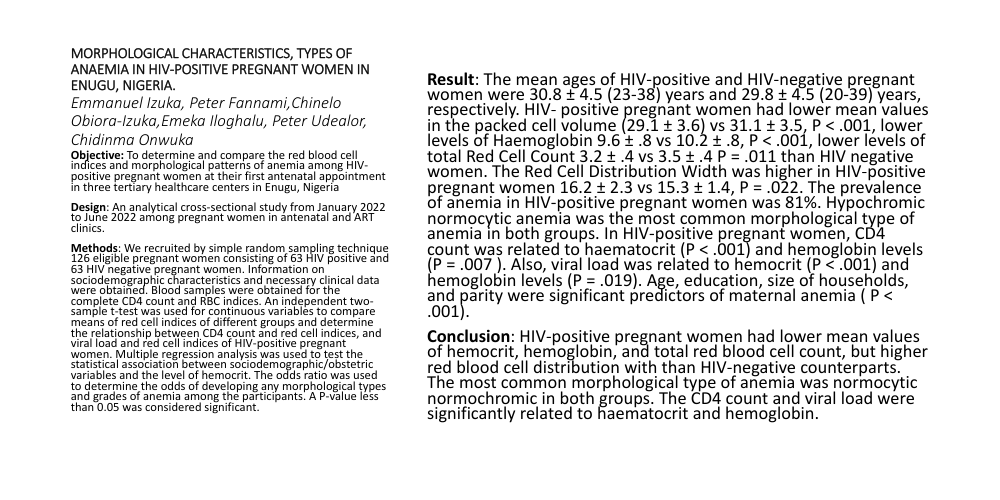
Objective: To determine and compare the red blood cell indices and morphological patterns of anemia among HIV-positive pregnant women at their first antenatal appointment in three tertiary healthcare centers in Enugu, Nigeria
Design: An analytical cross-sectional study from January 2022 to June 2022 among pregnant women in antenatal and ART clinics.
Methods: We recruited by simple random sampling technique 126 eligible pregnant women consisting of 63 HIV positive and 63 HIV negative pregnant women. Information on sociodemographic characteristics and necessary clinical data were obtained. Blood samples were obtained for the complete CD4 count and RBC indices. An independent two-sample t-test was used for continuous variables to compare means of red cell indices of different groups and determine the relationship between CD4 count and red cell indices, and viral load and red cell indices of HIV-positive pregnant women. Multiple regression analysis was used to test the statistical association between sociodemographic/obstetric variables and the level of hemocrit. The odds ratio was used to determine the odds of developing any morphological types and grades of anemia among the participants. A P-value less than 0.05 was considered significant.
Result: The mean ages of HIV-positive and HIV-negative pregnant women were 30.8 ± 4.5 (23-38) years and 29.8 ± 4.5 (20-39) years, respectively. HIV- positive pregnant women had lower mean values in the packed cell volume (29.1 ± 3.6) vs 31.1 ± 3.5, P < .001, lower levels of Haemoglobin 9.6 ± .8 vs 10.2 ± .8, P < .001, lower levels of total Red Cell Count 3.2 ± .4 vs 3.5 ± .4 P = .011 than HIV negative women. The Red Cell Distribution Width was higher in HIV-positive pregnant women 16.2 ± 2.3 vs 15.3 ± 1.4, P = .022. The prevalence of anemia in HIV-positive pregnant women was 81%. Hypochromic normocytic anemia was the most common morphological type of anemia in both groups. In HIV-positive pregnant women, CD4 count was related to haematocrit (P < .001) and hemoglobin levels (P = .007 ). Also, viral load was related to hemocrit (P < .001) and hemoglobin levels (P = .019). Age, education, size of households, and parity were significant predictors of maternal anemia ( P < .001).
Conclusion: HIV-positive pregnant women had lower mean values of hemocrit, hemoglobin, and total red blood cell count, but higher red blood cell distribution with than HIV-negative counterparts. The most common morphological type of anemia was normocytic normochromic in both groups. The CD4 count and viral load were significantly related to haematocrit and hemoglobin.