2,281 posters, 63 videos, 56 audios, 43 topics, 18 sessions, 6,174 authors, 2,323 institutions
ePostersLive by SciGen Technologies S.A. All rights reserved.
RCOG World Congress 2025
June 23 - 25, 2025 | ExCeL London, UK
EP.1342
Effect of mean arterial pressure on the neonate in spinal anesthesia
Poster Presenter
Authors
Affiliations
Part of Topic
Intrapartum care
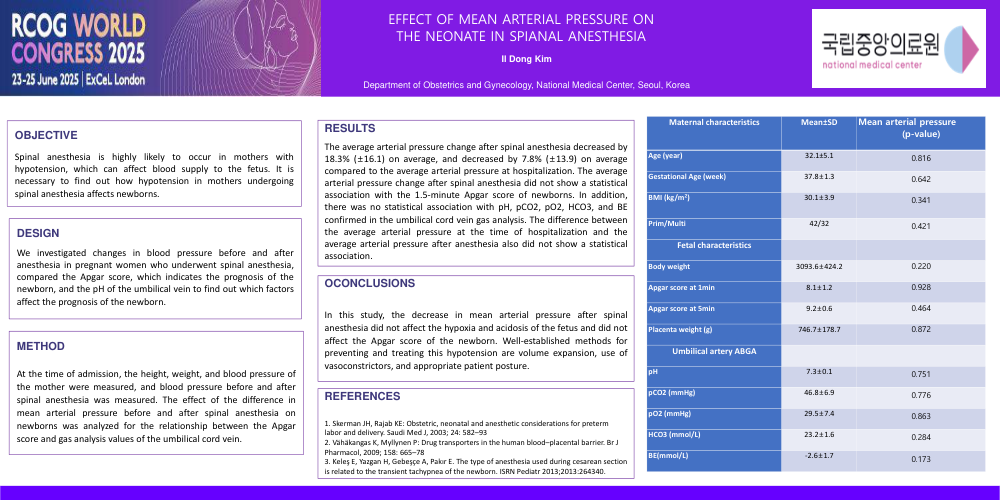
EFFECT OF MEAN ARTERIAL PRESSURE ON THE NEONATE IN SPIANAL ANESTHESIA
Il Dong Kim
Department of Obstetrics and Gynecology, National Medical Center, Seoul, Korea
OBJECTIVE
Spinal anesthesia is highly likely to occur in mothers with hypotension, which can affect blood supply to the fetus. It is necessary to find out how hypotension in mothers undergoing spinal anesthesia affects newborns.
DESIGN
We investigated changes in blood pressure before and after anesthesia in pregnant women who underwent spinal anesthesia, compared the Apgar score, which indicates the prognosis of the newborn, and the pH of the umbilical vein to find out which factors affect the prognosis of the newborn.
Method
At the time of admission, the height, weight, and blood pressure of the mother were measured, and blood pressure before and after spinal anesthesia was measured. The effect of the difference in mean arterial pressure before and after spinal anesthesia on newborns was analyzed for the relationship between the Apgar score and gas analysis values of the umbilical cord vein.
Results
The average arterial pressure change after spinal anesthesia decreased by 18.3% (±16.1) on average, and decreased by 7.8% (±13.9) on average compared to the average arterial pressure at hospitalization. The average arterial pressure change after spinal anesthesia did not show a statistical association with the 1.5-minute Apgar score of newborns. In addition, there was no statistical association with pH, pCO2, pO2, HCO3, and BE confirmed in the umbilical cord vein gas analysis. The difference between the average arterial pressure at the time of hospitalization and the average arterial pressure after anesthesia also did not show a statistical association.
OCONCLUSIONS
In this study, the decrease in mean arterial pressure after spinal anesthesia did not affect the hypoxia and acidosis of the fetus and did not affect the Apgar score of the newborn. Well-established methods for preventing and treating this hypotension are volume expansion, use of vasoconstrictors, and appropriate patient posture.
References
1. Skerman JH, Rajab KE: Obstetric, neonatal and anesthetic considerations for preterm labor and delivery. Saudi Med J, 2003; 24: 582–93
2. Vähäkangas K, Myllynen P: Drug transporters in the human blood–placental barrier. Br J Pharmacol, 2009; 158: 665–78
3. Keleş E, Yazgan H, Gebeşçe A, Pakır E. The type of anesthesia used during cesarean section is related to the transient tachypnea of the newborn. ISRN Pediatr 2013;2013:264340