Loading...

2,281 posters, 63 videos, 56 audios, 43 topics, 18 sessions, 6,174 authors, 2,323 institutions

ePostersLive by SciGen Technologies S.A. All rights reserved.

RCOG World Congress 2025

June 23 - 25, 2025 | ExCeL London, UK

EP.1340

Nipple stimulation and third stage of labour: systematic review and meta-analysis
Part of Topic

Intrapartum care

THE EFFECT OF EARLY NIPPLE STIMULATION ON THIRD STAGE OF LABOUR DURATION AND ESTIMATED BLOOD LOSS: A SYSTEMATIC REVIEW AND META-ANALYSIS

Zoe Y. Zervides1,2, Maria M. Witkowiak2, Dana O. Alzoubi2, Reem B. Zalloum3, Natalie E. Bourdakos1,2, Fatma A.M. Abdulsalam,4, Hayato Nakanishi5, Christian A. Than1,2,6, Shavi Fernando 7, Sir Sabaratnam Arulkumaran1

Aim

To assess whether early nipple stimulation (ENS) following uncomplicated deliveries effects the duration of the third stage of labour and estimated blood loss.


Background

•Post-partum haemorrhage due to uterine atony remains a leading cause of maternal mortality worldwide, predominantly occurring in under resourced settings.
•The risk increases with prolonged duration of the third stage of labour. ENS promotes the early release of oxytocin, which has beneficial effects on uterine tone, potentially decreasing length of third stage and estimated blood loss1,2.
 

Methods

•A search was conducted in Pubmed, Embase, Cochrane, CiNAHL, Scopus and Web of Science, covering studies published up to 02.05.24. This initially yielded 407 studies.
•32 articles were considered suitable for further assessment and 9 studies including 789 women, met inclusion criteria.
•3 studies were randomised controlled trials and the other 6 were a prospective cohort study design
•The following maternal outcomes were extracted: EBL (mL), length of third stage of labour (min), uterine tone and the success of the first breastfeed.
 

Conclusion

•Some evidence that ENS may reduce both the duration of the third stage of labour and blood loss.
•Our findings support the incorporation of ENS in routine labour management, ESPECIALLY in settings where access to uterotonics is limited.
•Additional need to explore the benefits of ENS with higher quality research, as there is little to lose and much to gain.
 

Duration of Third Stage of Labour

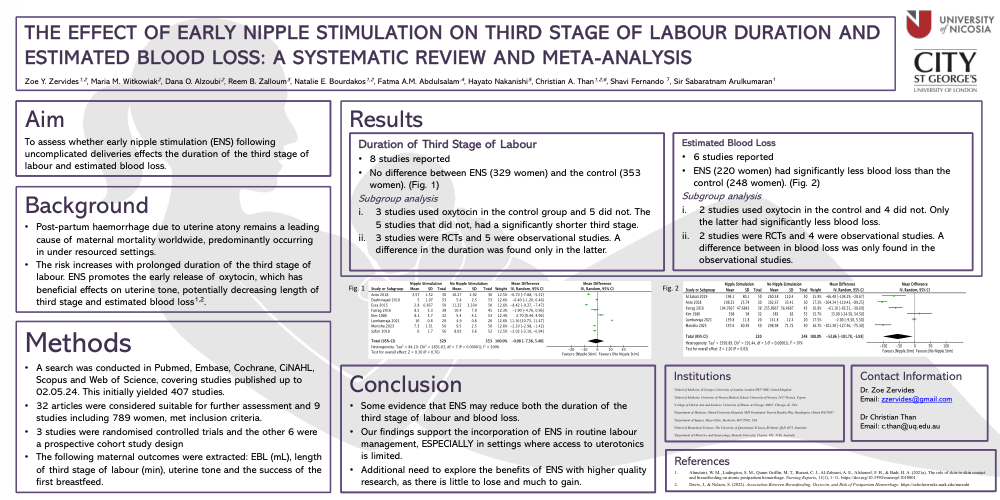
•8 studies reported
•No difference between ENS (329 women) and the control (353 women). (Fig. 1)

Subgroup analysis

i.3 studies used oxytocin in the control group and 5 did not. The 5 studies that did not, had a significantly shorter third stage.
ii.3 studies were RCTs and 5 were observational studies. A difference in the duration was found only in the latter.
 

Estimated Blood Loss

•6 studies reported
•ENS (220 women) had significantly less blood loss than the control (248 women). (Fig. 2)

Subgroup analysis

i.2 studies used oxytocin in the control and 4 did not. Only the latter had significantly less blood loss.
ii.2 studies were RCTs and 4 were observational studies. A difference between in blood loss was only found in the observational studies.
Copyright © 2015-2026, ePostersLive® SciGen is a registered trademark of SciGen Technologies S.A. Patent pending.

This website and third-party tools we use rely on cookies for the best user experience. By selecting "I agree", you agree to cookie usage as described in our Privacy Policy.