2,281 posters, 63 videos, 56 audios, 43 topics, 18 sessions, 6,174 authors, 2,323 institutions
ePostersLive by SciGen Technologies S.A. All rights reserved.
RCOG World Congress 2025
June 23 - 25, 2025 | ExCeL London, UK
EP.2279
Improving the Safety of Hormone Replacement Therapy (HRT) Prescribing in Primary Care
Poster Presenter
Authors
Affiliations
Part of Topic
Menopause
Improving the Safety of Hormone Replacement Therapy (HRT) Prescribing in Primary Care
Objectives
HRT is a core component of treating menopausal symptoms, but it must be prescribed safely. Crucially, patients with a uterus on oestrogenic HRT must also have a concomitant progesterone component to provide protection against endometrial hyperplasia, a major risk factor for endometrial cancer. Therefore, HRT prescription and documentation was evaluated, and steps taken to try and improve practice.
Design
A closed loop quality improvement project (QIP) was performed. This was based on a cogent Plan-Do-Study-Act structure, which extracted data from electronic patient records at a large Northwest London GP practice.
Methods
All the registered patients with oestrogen prescribed within the past six months were identified. Their digital records were then checked for the safe co-prescription of progesterone, or a Mirena intrauterine system (IUS) inserted within the past five years, or a preventative factor against endometrial cancer such as previous total hysterectomy. Additionally, clinicians’ notes were assessed for how HRT reviews had been undertaken and documented.
Results
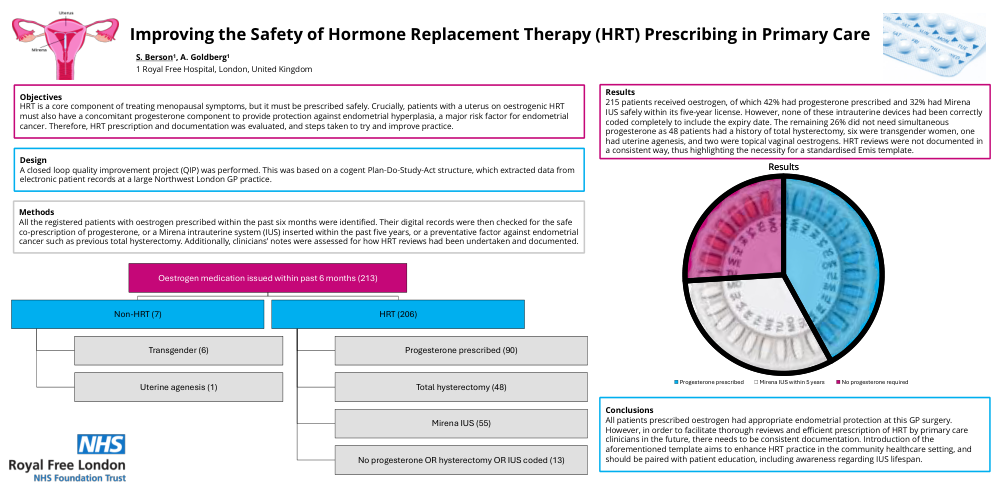
215 patients received oestrogen, of which 42% had progesterone prescribed and 32% had Mirena IUS safely within its five-year license. However, none of these intrauterine devices had been correctly coded completely to include the expiry date. The remaining 26% did not need simultaneous progesterone as 48 patients had a history of total hysterectomy, six were transgender women, one had uterine agenesis, and two were topical vaginal oestrogens. HRT reviews were not documented in a consistent way, thus highlighting the necessity for a standardised Emis template.
Conclusions
All patients prescribed oestrogen had appropriate endometrial protection at this GP surgery. However, in order to facilitate thorough reviews and efficient prescription of HRT by primary care clinicians in the future, there needs to be consistent documentation. Introduction of the aforementioned template aims to enhance HRT practice in the community healthcare setting, and should be paired with patient education, including awareness regarding IUS lifespan.