2,281 posters, 63 videos, 56 audios, 43 topics, 18 sessions, 6,174 authors, 2,323 institutions
ePostersLive by SciGen Technologies S.A. All rights reserved.
RCOG World Congress 2025
June 23 - 25, 2025 | ExCeL London, UK
EP.1728
Understanding Sleep Disturbance in Postmenopausal Women through Wearable Devices and Mobile Applications
Poster Presenter
Part of Topic
Menopause
Understanding Sleep Disturbance in Postmenopausal Women through Wearable Devices and Mobile Applications
Joehl Nguyen1, Kristen Rosen2*, Senka Djordjevic3, Ann Kathrin Frenz4, Kelly Genga5 , Bahiyyih Schmalenberg6 Anna-Katharina Meinecke4, Nils Schoof7
1. Bayer HealthCare Pharmaceuticals Inc., Whippany, New Jersey, US; 2. Evidation Health, Inc, San Mateo, California, US; 3. Bayer Consumer Care AG, Basel, Switzerland ; 4. Bayer AG, Wuppertal, Germany; 5. Bayer SA, Sao Paulo, Brazil; 6. Bayer Inc, Mississauga, Ontario, Canada; 7. Bayer AG, Berlin, Germany
Objectives
Sleep disturbance and vasomotor symptoms (VMS) are frequent and disruptive symptoms for women during menopause; these symptoms can also be interconnected. Commercial wearable devices are widely used but the relationship between objective sleep measures collected through devices and menopause symptoms has not been investigated. This study examined the relationship between wearable sleep measures and self-reported menopausal symptoms including nighttime VMS and VMS severity.
Design
The Evidation mobile application was used to survey postmenopausal women on VMS burden and sleep disturbance. Women consented to completing the survey and to linking wearable device data to their responses.
Methods
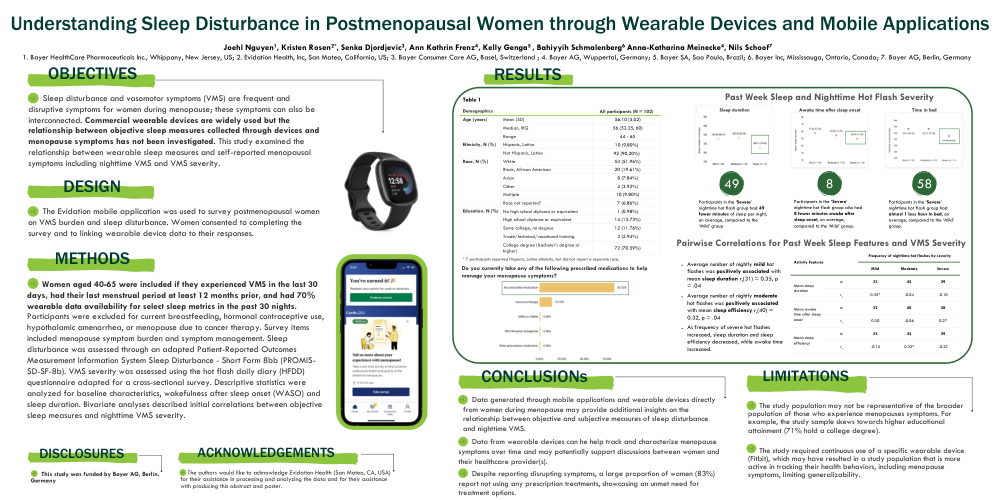
Women aged 40-65 were included if they experienced VMS in the last 30 days, had their last menstrual period at least 12 months prior, and had 70% wearable data availability for select sleep metrics in the past 30 nights. Participants were excluded for current breastfeeding, hormonal contraceptive use, hypothalamic amenorrhea, or menopause due to cancer therapy. Survey items included menopause symptom burden and symptom management. Sleep disturbance was assessed through an adapted Patient-Reported Outcomes Measurement Information System Sleep Disturbance - Short Form 8bb (PROMIS-SD-SF-8b). VMS severity was assessed using the hot flash daily diary (HFDD) questionnaire adapted for a cross-sectional survey. Descriptive statistics were analyzed for baseline characteristics, wakefulness after sleep onset (WASO) and sleep duration. Bivariate analyses described initial correlations between objective sleep measures and nighttime VMS severity.
Results
Participants in the ‘Severe’ nighttime hot flash group had 49 fewer minutes of sleep per night, on average, compared to the ‘Mild’ group.
Participants in the ‘Severe’ nighttime hot flash group also had 8 fewer minutes awake after sleep onset, on average, compared to the ‘Mild’ group.
Participants in the ‘Severe’ nighttime hot flash group had almost 1 less hour in bed, on average, compared to the ‘Mild’ group.
Pairwise Correlations for Past Week Sleep Features and VMS Severity
Data generated through mobile applications and wearable devices directly from women during menopause may provide additional insights on the relationship between objective and subjective measures of sleep disturbance and nighttime VMS.
Data from wearable devices can he help track and characterize menopause symptoms over time and may potentially support discussions between women and their healthcare provider(s).
Despite reporting disrupting symptoms, a large proportion of women (83%) report not using any prescription treatments, showcasing an unmet need for treatment options.
Limitations
The study population may not be representative of the broader population of those who experience menopauses symptoms. For example, the study sample skews towards higher educational attainment (71% hold a college degree).
The study required continuous use of a specific wearable device (Fitbit), which may have resulted in a study population that is more active in tracking their health behaviors, including menopause symptoms, limiting generalizability.