2,281 posters, 63 videos, 56 audios, 43 topics, 18 sessions, 6,174 authors, 2,323 institutions
ePostersLive by SciGen Technologies S.A. All rights reserved.
RCOG World Congress 2025
June 23 - 25, 2025 | ExCeL London, UK
EP.1732
Vitamin D for Vulvovaginal Atrophy and Sexual Inactivity: Systematic Review Meta analysis
Poster Presenter
Authors
Affiliations
Cairo, New Cairo hospital, Alexandria University Faculty of Pharmacy
Part of Topic
Menopause
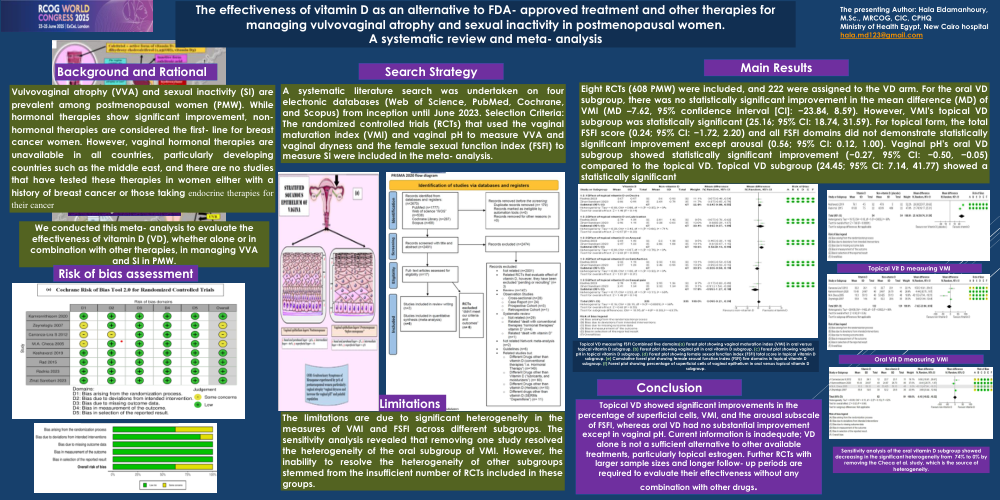
The effectiveness of vitamin D as an alternative to FDA- approved treatment and other therapies for managing vulvovaginal atrophy and sexual inactivity in postmenopausal women.
A systematic review and meta- analysis
Background and rational
Vulvovaginal atrophy (VVA) and sexual inactivity (SI) are prevalent among postmenopausal women (PMW). While hormonal therapies show significant improvement, non- hormonal therapies are considered the first- line for breast cancer women. However, vaginal hormonal therapies are unavailable in all countries, particularly developing countries such as the middle east, and there are no studies that have tested these therapies in women either with a history of breast cancer or those taking endocrine therapies for their cancer
We conducted this meta- analysis to evaluate the effectiveness of vitamin D (VD), whether alone or in combination with other therapies, in managing VVA and SI in PMW.
Search Strategy:
A systematic literature search was undertaken on four electronic databases (Web of Science, PubMed, Cochrane, and Scopus) from inception until June 2023. Selection Criteria: The randomized controlled trials (RCTs) that used the vaginal maturation index (VMI) and vaginal pH to measure VVA and vaginal dryness and the female sexual function index (FSFI) to measure SI were included in the meta- analysis.
Limitations
The limitations are due to significant heterogeneity in the measures of VMI and FSFI across different subgroups. The sensitivity analysis revealed that removing one study resolved the heterogeneity of the oral subgroup of VMI. However, the inability to resolve the heterogeneity of other subgroups stemmed from the insufficient number of RCTs included in these groups.
Main Results
Eight RCTs (608 PMW) were included, and 222 were assigned to the VD arm. For the oral VD subgroup, there was no statistically significant improvement in the mean difference (MD) of VMI (MD –7.62, 95% confidence interval [CI]: −23.84, 8.59). However, VMI's topical VD subgroup was statistically significant (25.16; 95% CI: 18.74, 31.59). For topical form, the total FSFI score (0.24; 95% CI: −1.72, 2.20) and all FSFI domains did not demonstrate statistically significant improvement except arousal (0.56; 95% CI: 0.12, 1.00). Vaginal pH's oral VD subgroup showed statistically significant improvement (−0.27, 95% CI: −0.50, −0.05) compared to the topical VD. Topical VD subgroup (24.45; 95% CI: 7.14, 41.77) showed a statistically significant
The Conclusion
Topical VD showed significant improvements in the percentage of superficial cells, VMI, and the arousal subscale of FSFI, whereas oral VD had no substantial improvement except in vaginal pH. Current information is inadequate; VD alone is not a sufficient alternative to other available treatments, particularly topical estrogen. Further RCTs with larger sample sizes and longer follow- up periods are required to evaluate their effectiveness without any combination with other drugs.