2,281 posters, 63 videos, 56 audios, 43 topics, 18 sessions, 6,174 authors, 2,323 institutions
ePostersLive by SciGen Technologies S.A. All rights reserved.
RCOG World Congress 2025
June 23 - 25, 2025 | ExCeL London, UK
EP.1730
MARIE-Singapore (WP2a): A Mixed-Methods Study Exploring Menopause (Interim analysis)
Poster Presenter
Authors
ieera Aggarwal, Jie Sun, Rukshini Puvanendran, Farah Safdar, Rajeswari Kathirvel, Manisha Mathur, Raksha Aiyappan, Teck Hock Toh, Paula Briggs, Julie Taylor, Om Kurmi, Kathleen Riach, Sharron Hinchliff, Carol Atkinson, Kristina Potocnik, Vikram Talaulikar, Lucky Saraswat, Qing shi Jian, Sohier Elneil, Nirmala Rathanayake, Vindya Pathiraja, Jeremy Van Vlymen, Tharanga Mudalige, Heitor Cavalini, Yassine Bouchareb, George Uchenna Eleje, Fred Tweneboah-Koduah, Nana Mintah-Afful, Cristina Benetti-Pinto, Helen Felicity Kemp, Peter Phiri, Gayathri Delanerolle
Affiliations
University of Edinburgh, Nnamdi Azikiwe University, University of Aberdeen, Southern University of Science and Technology, University of Ruhuna, University of Birmingham, Sultan Qaboos University, KK Women's and Children Hospital, Lee Kong Chian School of Medicine, Sibu Hospital, Liverpool Women’s Hospital Foundation NHS Trust, University of Coventry, University of Sheffield, Manchester Metropolitan University, University College London Hospitals NHS Foundation Trust, Hampshire and Isle of Wight Healthcare NHS Foundation Trust,, Narh-Bita Hospital, Ethos Clinic, University of Campinas, Hampshire and Isle of Wight Healthcare NHS Foundation Trust,University of Southampton, Hampshire and Isle of Wight Healthcare NHS Foundation Trust,University of Birmingham
Part of Topic
Menopause
Background: Menopause is a significant life transition for women, often accompanied by various physical, emotional and psychological symptoms. In Singapore, the demographic shift towards an aging population has led to an increased number of women experiencing menopause and its consequences. Despite its prevalence, there is limited research on the experiences and management of menopausal symptoms among Singaporean women. Given the multiethnic local population with its varied beliefs, the importance of understanding the impact of menopause on Singaporean women’s physical and mental health is vital to providing holistic care.
Objective: To report the population characteristics of menopausal women and impact of menopause on women’s health.
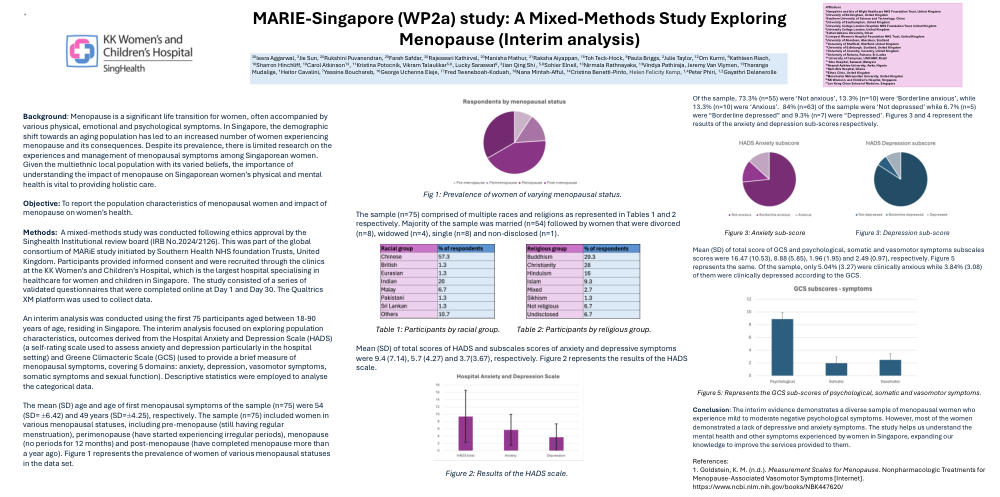
Methods: A mixed-methods study was conducted following ethics approval by the Singhealth Institutional review board (IRB No.2024/2126). This was part of the global consortium of MARiE study initiated by Southern Health NHS foundation Trusts, United Kingdom. Participants provided informed consent and were recruited through the clinics at the KK Women’s and Children’s Hospital, which is the largest hospital specialising in healthcare for women and children in Singapore. The study consisted of a series of validated questionnaires that were completed online at Day 1 and Day 30. The Qualtrics XM platform was used to collect data. An interim analysis was conducted using the first 75 participants aged between 18-90 years of age, residing in Singapore. The interim analysis focused on exploring population characteristics, outcomes derived from the Hospital Anxiety and Depression Scale (HADS) (a self-rating scale used to assess anxiety and depression particularly in the hospital setting) and Greene Climacteric Scale (GCS) (used to provide a brief measure of menopausal symptoms, covering 5 domains: anxiety, depression, vasomotor symptoms, somatic symptoms and sexual function). Descriptive statistics were employed to analyse the categorical data. The mean (SD) age and age of first menopausal symptoms of the sample (n=75) were 54 (SD= ±6.42) and 49 years (SD=±4.25), respectively. The sample (n=75) included women in various menopausal statuses, including pre-menopause (still having regular menstruation), perimenopause (have started experiencing irregular periods), menopause (no periods for 12 months) and post-menopause (have completed menopause more than a year ago). Figure 1 represents the prevalence of women of various menopausal statuses in the data set. Of the sample, 73.3% (n=55) were ‘Not anxious’, 13.3% (n=10) were ‘Borderline anxious’, while 13.3% (n=10) were ‘Anxious’. 84% (n=63) of the sample were ‘Not depressed’ while 6.7% (n=5) were “Borderline depressed” and 9.3% (n=7) were “Depressed’. Figures 3 and 4 represent the results of the anxiety and depression sub-scores respectively. Figure 3: Anxiety sub-score Figure 3: Depression sub-score Mean (SD) of total score of GCS and psychological, somatic and vasomotor symptoms subscales scores were 16.47 (10.53), 8.88 (5.85), 1.96 (1.95) and 2.49 (0.97), respectively. Figure 5 represents the same. Of the sample, only 5.04% (3.27) were clinically anxious while 3.84% (3.08) of them were clinically depressed according to the GCS.
Conclusion: The interim evidence demonstrates a diverse sample of menopausal women who experience mild to moderate negative psychological symptoms. However, most of the women demonstrated a lack of depressive and anxiety symptoms. The study helps us understand the mental health and other symptoms experienced by women in Singapore, expanding our knowledge to improve the services provided to them. References: 1. Goldstein, K. M. (n.d.). Measurement Scales for Menopause. Nonpharmacologic Treatments for Menopause-Associated Vasomotor Symptoms [Internet]. https://www.ncbi.nlm.nih.gov/books/NBK447620/