2,281 posters, 63 videos, 56 audios, 43 topics, 18 sessions, 6,174 authors, 2,323 institutions
ePostersLive by SciGen Technologies S.A. All rights reserved.
RCOG World Congress 2025
June 23 - 25, 2025 | ExCeL London, UK
EP.1729
Real-world usage and perceptions of antidepressants for vasomotor symptoms associated with menopause
Poster Presenter
Part of Topic
Menopause
Real-world usage and perceptions of antidepressants for vasomotor symptoms associated with menopause
Joehl Nguyen1, Senka Djordjevic2, Jessica Robinson3, Megan Scott3, Nils Schoof4
1. Bayer US, LLC, Whippany, USA; 2. Bayer Consumer Care AG, Basel, Switzerland; 3. Adelphi Real World, Bollington, UK; 4. Bayer AG, Berlin, Germany
Introduction
Vasomotor symptoms (VMS; also referred to as hot flushes or night sweats), occur in approximately 75–80% of menopausal women and have a significant negative impact on women’s quality of life (QoL), both physically and psychosocially1,2. Despite this, there is little pre-existing literature on the real-world treatment dynamics and physician perspectives of current VMS treatments, particularly antidepressants (ADs)3.
The objective of this study is to describe real-world treatment patterns and physician perception of AD, specifically selective - serotonin and serotonin - norepinephrine reuptake inhibitors (SSRI/SNRIs) in postmenopausal women with VMS associated with menopause in the United States (US).
Design
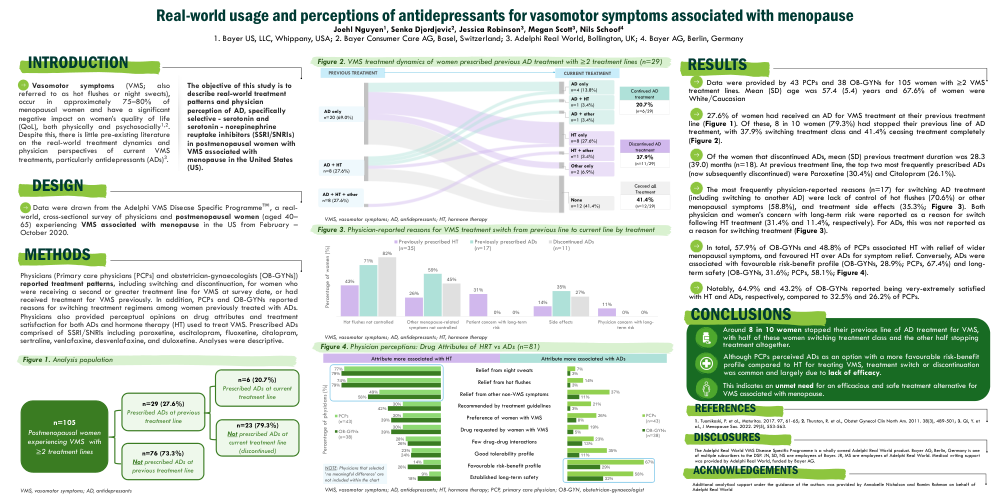
Data were drawn from the Adelphi VMS Disease Specific Programme™, a real-world, cross-sectional survey of physicians and postmenopausal women (aged 40–65) experiencing VMS associated with menopause in the US from February – October 2020.
Methods
Physicians (Primary care physicians [PCPs] and obstetrician-gynaecologists [OB-GYNs]) reported treatment patterns, including switching and discontinuation, for women who were receiving a second or greater treatment line for VMS at survey date, or had received treatment for VMS previously. In addition, PCPs and OB-GYNs reported reasons for switching treatment regimens among women previously treated with ADs. Physicians also provided perceptual opinions on drug attributes and treatment satisfaction for both ADs and hormone therapy (HT) used to treat VMS. Prescribed ADs comprised of SSRI/SNRIs including paroxetine, escitalopram, fluoxetine, citalopram, sertraline, venlafaxine, desvenlafaxine, and duloxetine. Analyses were descriptive.
Results
Data were provided by 43 PCPs and 38 OB-GYNs for 105 women with ≥2 VMS treatment lines. Mean (SD) age was 57.4 (5.4) years and 67.6% of women were White/Caucasian
27.6% of women had received an AD for VMS treatment at their previous treatment line (Figure 1). Of these, 8 in 10 women (79.3%) had stopped their previous line of AD treatment, with 37.9% switching treatment class and 41.4% ceasing treatment completely (Figure 2).
Of the women that discontinued ADs, mean (SD) previous treatment duration was 28.3 (39.0) months (n=18). At previous treatment line, the top two most frequently prescribed ADs (now subsequently discontinued) were Paroxetine (30.4%) and Citalopram (26.1%).
The most frequently physician-reported reasons (n=17) for switching AD treatment (including switching to another AD) were lack of control of hot flushes (70.6%) or other menopausal symptoms (58.8%), and treatment side effects (35.3%; Figure 3). Both physician and women’s concern with long-term risk were reported as a reason for switch following HT treatment (31.4% and 11.4%, respectively). For ADs, this was not reported as a reason for switching treatment (Figure 3).
In total, 57.9% of OB-GYNs and 48.8% of PCPs associated HT with relief of wider menopausal symptoms, and favoured HT over ADs for symptom relief. Conversely, ADs were associated with favourable risk-benefit profile (OB-GYNs, 28.9%; PCPs, 67.4%) and long-term safety (OB-GYNs, 31.6%; PCPs, 58.1%; Figure 4).
Notably, 64.9% and 43.2% of OB-GYNs reported being very-extremely satisfied with HT and ADs, respectively, compared to 32.5% and 26.2% of PCPs.
Conclusions
Around 8 in 10 women stopped their previous line of AD treatment for VMS, with half of these women switching treatment class and the other half stopping treatment altogether.
Although PCPs perceived ADs as an option with a more favourable risk-benefit profile compared to HT for treating VMS, treatment switch or discontinuation was common and largely due to lack of efficacy.
This indicates an unmet need for an efficacious and safe treatment alternative for VMS associated with menopause.