2,281 posters, 63 videos, 56 audios, 43 topics, 18 sessions, 6,174 authors, 2,323 institutions
ePostersLive by SciGen Technologies S.A. All rights reserved.
RCOG World Congress 2025
June 23 - 25, 2025 | ExCeL London, UK
EP.1756
HRT Implants: Their role and importance in menopause practise today
Poster Presenter
Part of Topic
Menopause
HRT IMPLANTS: Their role in menopause practice today
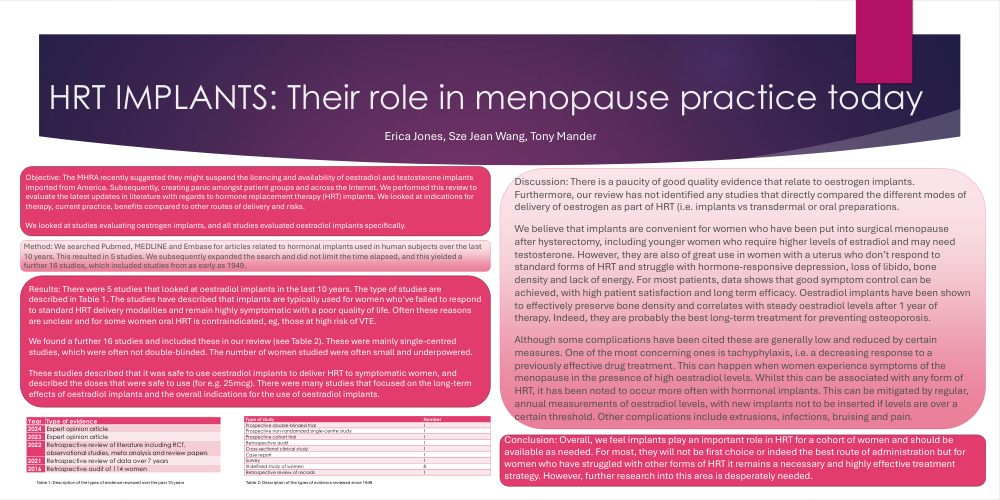
Objective: The MHRA recently suggested they might suspend the licencing and availability of oestradiol and testosterone implants imported from America. Subsequently, creating panic amongst patient groups and across the Internet. We performed this review to evaluate the latest updates in literature with regards to hormone replacement therapy (HRT) implants. We looked at indications for therapy, current practice, benefits compared to other routes of delivery and risks.
We looked at studies evaluating oestrogen implants, and all studies evaluated oestradiol implants specifically
Method: We searched Pubmed, MEDLINE and Embase for articles related to hormonal implants used in human subjects over the last 10 years. This resulted in 5 studies. We subsequently expanded the search and did not limit the time elapsed, and this yielded a further 16 studies, which included studies from as early as 1949.
Results: There were 5 studies that looked at oestradiol implants in the last 10 years. The type of studies are described in Table 1. The studies have described that implants are typically used for women who’ve failed to respond to standard HRT delivery modalities and remain highly symptomatic with a poor quality of life. Often these reasons are unclear and for some women oral HRT is contraindicated, eg, those at high risk of VTE.
We found a further 16 studies and included these in our review (see Table 2). These were mainly single-centred studies, which were often not double-blinded. The number of women studied were often small and underpowered.
These studies described that it was safe to use oestradiol implants to deliver HRT to symptomatic women, and described the doses that were safe to use (for e.g. 25mcg). There were many studies that focused on the long-term effects of oestradiol implants and the overall indications for the use of oestradiol implants.
Discussion: There is a paucity of good quality evidence that relate to oestrogen implants. Furthermore, our review has not identified any studies that directly compared the different modes of delivery of oestrogen as part of HRT (i.e. implants vs transdermal or oral preparations.
We believe that implants are convenient for women who have been put into surgical menopause after hysterectomy, including younger women who require higher levels of estradiol and may need testosterone. However, they are also of great use in women with a uterus who don’t respond to standard forms of HRT and struggle with hormone-responsive depression, loss of libido, bone density and lack of energy. For most patients, data shows that good symptom control can be achieved, with high patient satisfaction and long term efficacy. Oestradiol implants have been shown to effectively preserve bone density and correlates with steady oestradiol levels after 1 year of therapy. Indeed, they are probably the best long-term treatment for preventing osteoporosis.
Although some complications have been cited these are generally low and reduced by certain measures. One of the most concerning ones is tachyphylaxis, i.e. a decreasing response to a previously effective drug treatment. This can happen when women experience symptoms of the menopause in the presence of high oestradiol levels. Whilst this can be associated with any form of HRT, it has been noted to occur more often with hormonal implants. This can be mitigated by regular, annual measurements of oestradiol levels, with new implants not to be inserted if levels are over a certain threshold. Other complications include extrusions, infections, bruising and pain.
Conclusion: Overall, we feel implants play an important role in HRT for a cohort of women and should be available as needed. For most, they will not be first choice or indeed the best route of administration but for women who have struggled with other forms of HRT it remains a necessary and highly effective treatment strategy. However, further research into this area is desperately needed.