2,281 posters, 63 videos, 56 audios, 43 topics, 18 sessions, 6,174 authors, 2,323 institutions
ePostersLive by SciGen Technologies S.A. All rights reserved.
RCOG World Congress 2025
June 23 - 25, 2025 | ExCeL London, UK
EP.1751
Audit to determine whether adequate endometrial protection is prescribed in menopause HRT
Poster Presenter
Authors
Affiliations
Part of Topic
Menopause
An Audit to Determine Whether Adequate Endometrial Protection is Prescribed in Menopause HRT
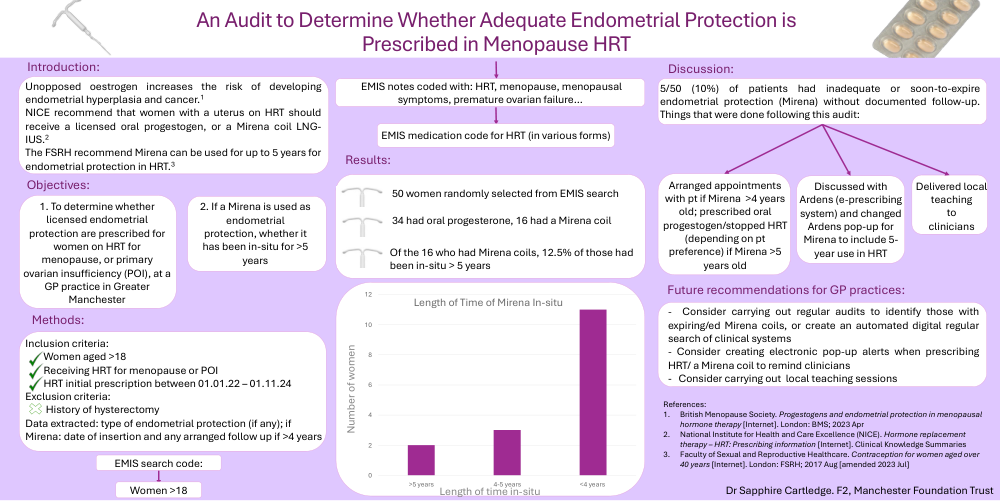
Objective: NICE guidelines state a licensed oral progestogen, or Mirena LNG-IUS can be used for up to five years for endometrial protection in a menopause HRT regimen. This audit aims to determine whether women with a uterus being started on HRT for menopause, or premature ovarian failure, have a licensed oral progestogen prescribed or Mirena levonorgestrel-releasing intrauterine system (LNG-IUS) within a licensed duration in a GP practise in greater Manchester.
Methods: An EMIS search was built using codes including women >18 + code: HRT, menopause, menopausal symptoms etc. + an oestrogen prescribed between 01.01.22 to 01.11.24. From this list, 50 patients were randomly selected who had HRT initiated from 01.01.22 to 01.11.24. Data was collected on type of oestrogen, and progestogen prescribed, or whether a Mirena in-situ was within licensed date for menopause.
Results: 50 patients were randomly selected from the list of patients generated from the codes. Patients aged from 43 to 61. 16 had an LNG-IUS in-situ, and 34 had an oral progestogen prescribed. Of these 34, oral progestogens were licensed for endometrial protection in menopause. Of the 16 with a LNG-IUS, two were >five years, and three were expiring within the next six months with no advice for women to change their Mirena.
Conclusions: In conclusion, the majority of patients had adequate endometrial protection prescribed. Of those who had a Mirena, two were over the licensed HRT duration, and three were expiring in the next six months. These women were contacted to advise them to change their Mirena, or to prescribe an oral progestogen. Local teaching was delivered to clinical staff at the GP practise. Ardens, the IT managers of EMIS, were contacted and their pop-up clinical safety warning has been updated to warn clinicians about expiring Mirena. Other measures GPs could consider include an electronic code which automatically alerts patients on HRT when their Mirenas are near expiry. Furthermore, GP practises could conduct a regular electronic search of women on HRT with a Mirena to identify those whose Mirenas are expiring to advise them to change it.