2,281 posters, 63 videos, 56 audios, 43 topics, 18 sessions, 6,174 authors, 2,323 institutions
ePostersLive by SciGen Technologies S.A. All rights reserved.
RCOG World Congress 2025
June 23 - 25, 2025 | ExCeL London, UK
EP.1738
Genitourinary Syndrome of Menopause: what impact on female sexuality?
Poster Presenter
Authors
Narjes Karmous, Abdelwaheb Masmoudi, Badreddine Bouguerra, Abdennour Karmous
Affiliations
Department of Gynaecology and Obstetrics, Charles Nicolle Hospital, Department B- Charles Nicolle Hospital, Gynaecology and Obstetrics Department B, Charles Nicolle Hospital, Department Bof Obstetrics and Gynaecology, Charles Nicolle Hospital, Department of Obstetrics and Gynecology B, Charles Nicolle Hospital, Gynaecology and Obstetrics Department B of Charles Nicolle Hospital, Gynaecology and Obstetrics department B- Charles Nicolle Hospital, Charles Nicolle Hospital, Obstetrics and Gynaecology Service B, Razi Hospital, Department B of Gynaecology and Obstetrics- Charles Nicolle Hospital, Department B of Obstetrics and Gynecology, Charles Nicolle Hospital
Part of Topic
Menopause
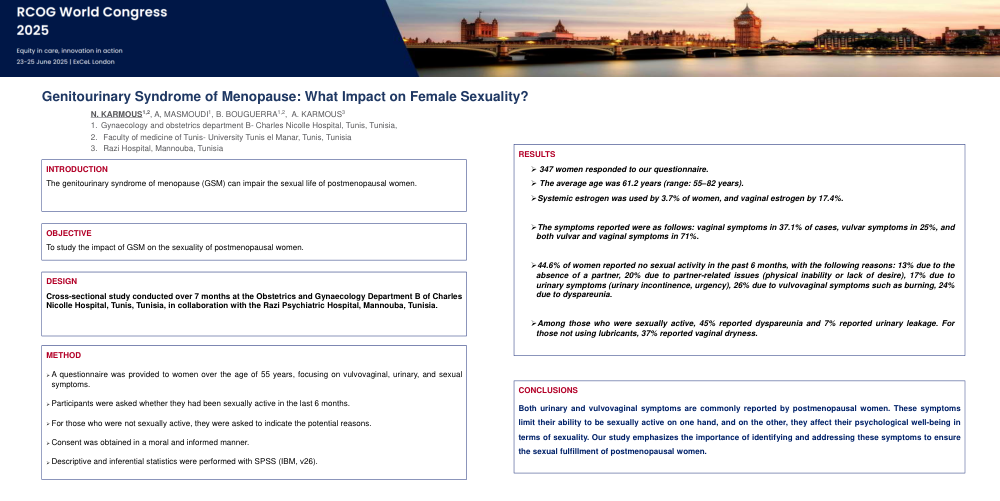
Genitourinary Syndrome of Menopause: What Impact on Female Sexuality?
Introduction: The genitourinary syndrome of menopause (GSM) can impair the sexual life of postmenopausal women.
Objective: To study the impact of GSM on the sexuality of postmenopausal women.
Method: Cross-sectional study conducted over 7 months at the Obstetrics and Gynaecology Department B of Charles Nicolle Hospital, Tunis, Tunisia, in collaboration with the Razi Psychiatric Hospital, Mannouba, Tunisia.
Design: A questionnaire was provided to women over the age of 55 years, focusing on vulvovaginal, urinary, and sexual symptoms. Participants were asked whether they had been sexually active in the last 6 months. For those who were not sexually active, they were asked to indicate the potential reasons. Consent was obtained in a moral and informed manner. Descriptive and inferential statistics were performed with SPSS (IBM, v26).
Results: 347 women responded to our questionnaire. The average age was 61.2 years (range: 55–82 years). Systemic estrogen was used by 3.7% of women, and vaginal estrogen by 17.4%.
The symptoms reported were as follows: vaginal symptoms in 37.1% of cases, vulvar symptoms in 25%, and both vulvar and vaginal symptoms in 71%.
44.6% of women reported no sexual activity in the past 6 months, with the following reasons: 13% due to the absence of a partner, 20% due to partner-related issues (physical inability or lack of desire), 17% due to urinary symptoms (urinary incontinence, urgency), 26% due to vulvovaginal symptoms such as burning, 24% due to dyspareunia.
Among those who were sexually active, 45% reported dyspareunia and 7% reported urinary leakage. For those not using lubricants, 37% reported vaginal dryness.
Conclusions: Both urinary and vulvovaginal symptoms are commonly reported by postmenopausal women. These symptoms limit their ability to be sexually active on one hand, and on the other, they affect their psychological well-being in terms of sexuality. Our study emphasizes the importance of identifying and addressing these symptoms to ensure the sexual fulfillment of postmenopausal women.