2,281 posters, 63 videos, 56 audios, 43 topics, 18 sessions, 6,174 authors, 2,323 institutions
ePostersLive by SciGen Technologies S.A. All rights reserved.
RCOG World Congress 2025
June 23 - 25, 2025 | ExCeL London, UK
EP.1438
Massive Keloid Scar Post-Caesarean: Counselling on Delivery Options and Surgical Challenges
Poster Presenter
Part of Topic
Intrapartum care
Massive Keloid Scar post-Caesarean Section:
Counselling on Delivery options & Surgical challenges
Authors: Dr Wan Idoracaera Calisa binti Ikhwan, Miss Hoda Elmoniry, Miss Nuha Yassin, Dr Aligha Purushothaman
Objective
This case report explores the
challenges of managing a high-risk
pregnancy complicated by a massive
keloid scar secondary to a prior
caesarean section. It examines the
challenges of counselling for Mode of
delivery; vaginal birth (VBAC) versus
elective caesarean section (ELSCS),
the surgical approach to entry and
closure of the abdominal wall and the
importance of timely antenatal
multidisciplinary involvement.
Genetic
Predisposition
Key factors contributing to
keloid formation in
C-section scars:
Immune
Response
Dysregulation
Fibroblast
Activation and
Collagen
Synthesis
Aberrant
Wound Healing
Mechanical
Factors
Growth Factors
and Cytokines
Histology: Sections show a nodular dermal scar
with focal thick hyalinised keloidal collagen
bundles. The lesion reaches the resection
margins. There is no evidence of malignancy.
:
Counselling on Delivery options & Surgical challenges
Authors: Dr Wan Idoracaera Calisa binti Ikhwan, Miss Hoda Elmoniry, Miss Nuha Yassin, Dr Aligha Purushothaman
Case Report
A 35-year-old G2P1 woman of Nigerian descent with a BMI of 28 presented at 40+2 weeks' gestation with a history of one caesarean section for fetal
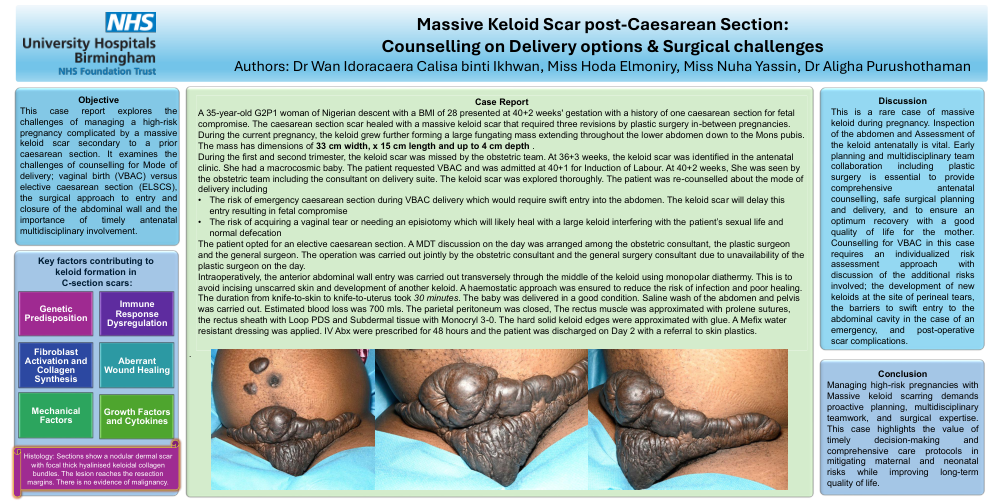
compromise. The caesarean section scar healed with a massive keloid scar that required three revisions by plastic surgery in-between pregnancies.
During the current pregnancy, the keloid grew further forming a large fungating mass extending throughout the lower abdomen down to the Mons pubis.
The mass has dimensions of 33 cm width, x 15 cm length and up to 4 cm depth .
During the first and second trimester, the keloid scar was missed by the obstetric team. At 36+3 weeks, the keloid scar was identified in the antenatal
clinic. She had a macrocosmic baby. The patient requested VBAC and was admitted at 40+1 for Induction of Labour. At 40+2 weeks, She was seen by
the obstetric team including the consultant on delivery suite. The keloid scar was explored thoroughly. The patient was re-counselled about the mode of
delivery including
• The risk of emergency caesarean section during VBAC delivery which would require swift entry into the abdomen. The keloid scar will delay this
entry resulting in fetal compromise
• The risk of acquiring a vaginal tear or needing an episiotomy which will likely heal with a large keloid interfering with the patient’s sexual life and
normal defecation
The patient opted for an elective caesarean section. A MDT discussion on the day was arranged among the obstetric consultant, the plastic surgeon
and the general surgeon. The operation was carried out jointly by the obstetric consultant and the general surgery consultant due to unavailability of the
plastic surgeon on the day.
Intraoperatively, the anterior abdominal wall entry was carried out transversely through the middle of the keloid using monopolar diathermy. This is to
avoid incising unscarred skin and development of another keloid. A haemostatic approach was ensured to reduce the risk of infection and poor healing.
The duration from knife-to-skin to knife-to-uterus took 30 minutes. The baby was delivered in a good condition. Saline wash of the abdomen and pelvis
was carried out. Estimated blood loss was 700 mls. The parietal peritoneum was closed, The rectus muscle was approximated with prolene sutures,
the rectus sheath with Loop PDS and Subdermal tissue with Monocryl 3-0. The hard solid keloid edges were approximated with glue. A Mefix water
resistant dressing was applied. IV Abx were prescribed for 48 hours and the patient was discharged on Day 2 with a referral to skin plastics.
Discussion
This is a rare case of massive
keloid during pregnancy. Inspection
of the abdomen and Assessment of
the keloid antenatally is vital. Early
planning and multidisciplinary team
collaboration including plastic
surgery is essential to provide
comprehensive antenatal
counselling, safe surgical planning
and delivery, and to ensure an
optimum recovery with a good
quality of life for the mother.
Counselling for VBAC in this case
requires an individualized risk
assessment approach with
discussion of the additional risks
involved; the development of new
keloids at the site of perineal tears,
the barriers to swift entry to the
abdominal cavity in the case of an
emergency, and post-operative
scar complications.
Conclusion
Managing high-risk pregnancies with
Massive keloid scarring demands
proactive planning, multidisciplinary
teamwork, and surgical expertise.
This case highlights the value of
timely decision-making and
comprehensive care protocols in
mitigating maternal and neonatal
risks while improving long-term quality of life