2,281 posters, 63 videos, 56 audios, 43 topics, 18 sessions, 6,174 authors, 2,323 institutions
ePostersLive by SciGen Technologies S.A. All rights reserved.
RCOG World Congress 2025
June 23 - 25, 2025 | ExCeL London, UK
EP.1432
A rare case of silent posterior uterine rupture in a VBAC patient
Poster Presenter
Authors
Affiliations
Part of Topic
Intrapartum care
Objective
We present a case of silent posterior uterine wall rupture in a VBAC patient. We discuss the difficulty in diagnosis of such ruptures in the absence of continuous electronic fetal monitoring (CEFM), the intraoperative management and the importance of individualised risk assessment and counselling.
Case report
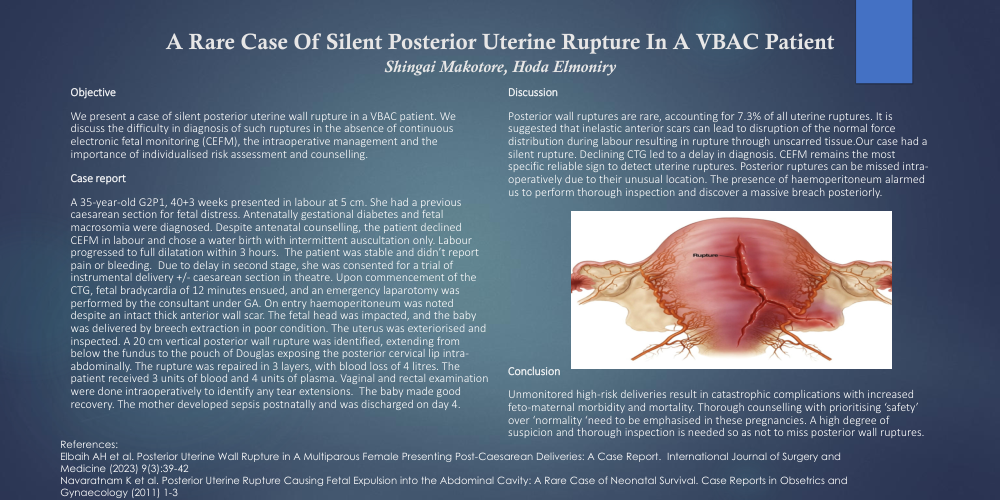
A 35-year-old G2P1, 40+3 weeks presented in labour at 5 cm. She had a previous caesarean section for fetal distress. Antenatally gestational diabetes and fetal macrosomia were diagnosed. Despite antenatal counselling, the patient declined CEFM in labour and chose a VBAC water birth with intermittent auscultation only. Labour progressed to full dilatation within 3 hours. The patient was stable and didn’t report pain or bleeding. Due to delay in the second stage, she was consented for a trial of instrumental delivery +/- caesarean section in theatre. Upon commencement of the CTG, fetal bradycardia of 12 minutes ensued, and an emergency laparotomy was performed by the consultant under GA. Upon entry hemoperitoneum was noted despite an intact thick anterior wall scar. The fetal head was impacted, and the baby was delivered by breech extraction in poor condition. The uterus was exteriorised and inspected posteriorly. A 20 cm vertical posterior wall rupture was identified, extending from below the fundus to the pouch of Douglas exposing the posterior cervical lip intra-abdominally. The rupture was repaired in 3 layers, with blood loss of 4 litres. The patient received 3 units of blood and 4 units plasma . A vaginal and rectal examination were done intraoperatively to identify any tear extensions. The baby made good recovery. The mother developed sepsis post-natally and was discharged on day 4.
Discussion
Posterior wall ruptures are rare, accounting for 7.3% of all uterine ruptures. It is suggested that inelastic anterior scars can lead to disruption of the normal force distribution during labour resulting in rupture through unscarred tissue.
Our case had a silent rupture. Declining CTG led to a delay in diagnosis. CEFM remains the most specific reliable sign to detect uterine ruptures.
Posterior ruptures can be missed intra-operatively due to their unusual location. The presence of haemoperitoneum alarmed us to perform thorough inspection and discover a massive breach posteriorly.
Conclusion
Unmonitored high-risk deliveries result in catastrophic complications with increased feto-maternal morbidity and mortality. Thorough counselling with prioritising ‘safety’ over ‘normality ‘need to be emphasized in these pregnancies. A high degree of suspicion and thorough inspection is needed so as not to miss posterior wall ruptures.