2,281 posters, 63 videos, 56 audios, 43 topics, 18 sessions, 6,174 authors, 2,323 institutions
ePostersLive by SciGen Technologies S.A. All rights reserved.
RCOG World Congress 2025
June 23 - 25, 2025 | ExCeL London, UK
EP.1428
Uterine Hyperstimulation in Spontaneous Labor Leading to Concealed Abruption: A Case Report
Poster Presenter
Authors
Affiliations
Part of Topic
Intrapartum care
Uterine Hyperstimulation in Spontaneous Labor Leading to Concealed Abruption: A Case Report
S Nasir1, F Harris2
Manchester University NHS Foundation Trust, Wythenshawe Hospital, Obstetrics and Gynaecology, Manchester, United Kingdom
Objective:
Case report:
To report a case of a hyperstimulation in spontaneous labor and concealed
placental abruption. It aims to
Illustrate clinical decision-making in acute obstetric emergencies
Highlight the importance of early recognition of placental abruption
Provide educational tools for interpreting ambiguous CTGs
Discussion:
The pathological causes for spontaneous uterine tachysystole are
suspected chorioamnionitis (subclinical and clinical) and Antepartum
hemorrhage. It has been shown that in cases of placental abruption during
the 2-h period preceding delivery the CTG showed five or more
contractions in 10min, with a mean of 5.6. It is vital to appreciate that
tocolysis may not be appropriate in women with uterine tachysystole
secondary to placental abruption or chorioamnionitis, especially if there
is maternal tachycardia or hypotension.
37 years old, P0+3 (recurrent miscarriages) at 41w1d, Midwife led care, reported to maternity triage in spontaneous labor with abdominal
pain. On initial assessment, a good resting tone was noted with no dilatation. The patient was on Aspirin and stopped at 36 weeks, non-
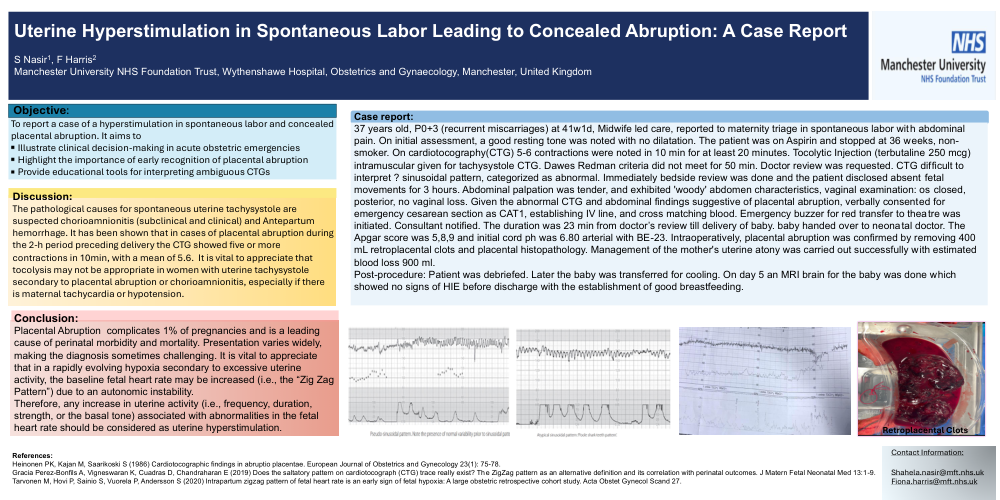
smoker. On cardiotocography(CTG) 5-6 contractions were noted in 10 min for at least 20 minutes. Tocolytic Injection (terbutaline 250 mcg)
intramuscular given for tachysystole CTG. Dawes Redman criteria did not meet for 50 min. Doctor review was requested. CTG difficult to
interpret ? sinusoidal pattern, categorized as abnormal. Immediately bedside review was done and the patient disclosed absent fetal
movements for 3 hours. Abdominal palpation was tender, and exhibited 'woody' abdomen characteristics, vaginal examination: os closed,
posterior, no vaginal loss. Given the abnormal CTG and abdominal findings suggestive of placental abruption, verbally consented for
emergency cesarean section as CAT1, establishing IV line, and cross matching blood. Emergency buzzer for red transfer to theatre was
initiated. Consultant notified. The duration was 23 min from doctor’s review till delivery of baby. baby handed over to neonatal doctor. The
Apgar score was 5,8,9 and initial cord ph was 6.80 arterial with BE-23. Intraoperatively, placental abruption was confirmed by removing 400
mL retroplacental clots and placental histopathology. Management of the mother's uterine atony was carried out successfully with estimated
blood loss 900 ml.
Post-procedure: Patient was debriefed. Later the baby was transferred for cooling. On day 5 an MRI brain for the baby was done which
showed no signs of HIE before discharge with the establishment of good breastfeeding.
Conclusion:
Placental Abruption complicates 1% of pregnancies and is a leading
cause of perinatal morbidity and mortality. Presentation varies widely,
making the diagnosis sometimes challenging. It is vital to appreciate
that in a rapidly evolving hypoxia secondary to excessive uterine
activity, the baseline fetal heart rate may be increased (i.e., the “Zig Zag
Pattern”) due to an autonomic instability.
Therefore, any increase in uterine activity (i.e., frequency, duration,
strength, or the basal tone) associated with abnormalities in the fetal
heart rate should be considered as uterine hyperstimulation.
Retroplacental Clots
References:
Heinonen PK, Kajan M, Saarikoski S (1986) Cardiotocographic findings in abruptio placentae. European Journal of Obstetrics and Gynecology 23(1): 75-78.
Gracia Perez-Bonfils A, Vigneswaran K, Cuadras D, Chandraharan E (2019) Does the saltatory pattern on cardiotocograph (CTG) trace really exist? The ZigZag pattern as an alternative definition and its correlation with perinatal outcomes. J Matern Fetal Neonatal Med 13:1-9.
Tarvonen M, Hovi P, Sainio S, Vuorela P, Andersson S (2020) Intrapartum zigzag pattern of fetal heart rate is an early sign of fetal hypoxia: A large obstetric retrospective cohort study. Acta Obstet Gynecol Scand 27.
Contact Information:
Shahela.nasir@mft.nhs.uk
Fiona.harris@mft.nhs.uk