2,281 posters, 63 videos, 56 audios, 43 topics, 18 sessions, 6,174 authors, 2,323 institutions
ePostersLive by SciGen Technologies S.A. All rights reserved.
RCOG World Congress 2025
June 23 - 25, 2025 | ExCeL London, UK
EP.1414
Dietary habits and other predictors of nutritional anemia among pregnant women
Part of Topic
Intrapartum care
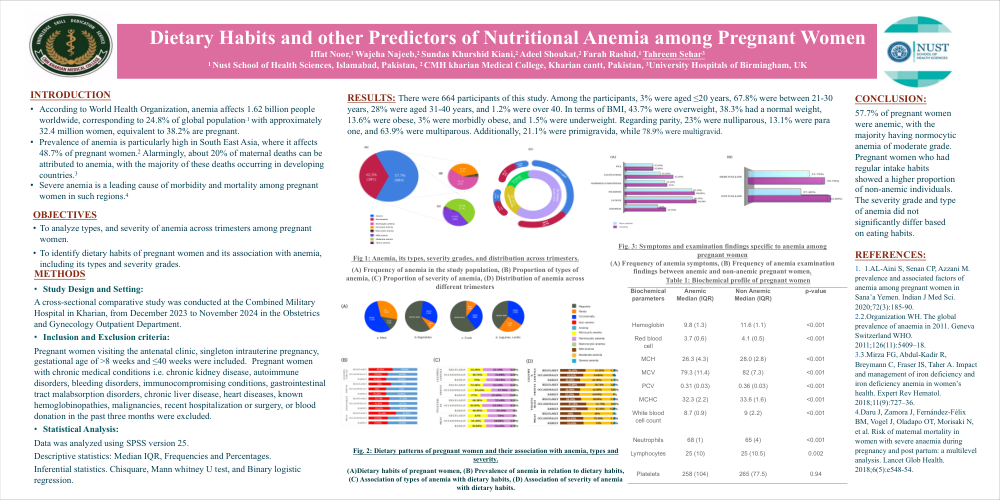
Dietary Habits and other Predictors of Nutritional Anemia among Pregnant Women
Iffat Noor,1 Wajeha Najeeb,2 Sundas Khurshid Kiani,2 Adeel Shoukat,2 Farah Rashid,1 Tahreem Sehar3
1 Nust School of Health Sciences, Islamabad, Pakistan, 2 CMH kharian Medical College, Kharian cantt, Pakistan, 3University Hospitals of Birmingham, UK
OBJECTIVES
To analyze types, and severity of anemia across trimesters among pregnant women. To identify dietary habits of pregnant women and its association with anemia, including its types and severity grades.
METHODS
Study Design and Setting: A cross-sectional comparative study was conducted at the Combined Military Hospital in Kharian, from December 2023 to November 2024 in the Obstetrics and Gynecology Outpatient Department. Inclusion and Exclusion criteria: Pregnant women visiting the antenatal clinic, singleton intrauterine pregnancy, gestational age of >8 weeks and ≤40 weeks were included. Pregnant women with chronic medical conditions i.e. chronic kidney disease, autoimmune disorders, bleeding disorders, immunocompromising conditions, gastrointestinal tract malabsorption disorders, chronic liver disease, heart diseases, known hemoglobinopathies, malignancies, recent hospitalization or surgery, or blood donation in the past three months were excluded. Statistical Analysis: Data was analyzed using SPSS version 25. Descriptive statistics: Median IQR, Frequencies and Percentages. Inferential statistics. Chisquare, Mann whitney U test, and Binary logistic regression.
CONCLUSION:
57.7% of pregnant women were anemic, with the majority having normocytic anemia of moderate grade. Pregnant women who had regular intake habits showed a higher proportion of non-anemic individuals. The severity grade and type of anemia did not significantly differ based on eating habits.