2,281 posters, 63 videos, 56 audios, 43 topics, 18 sessions, 6,174 authors, 2,323 institutions
ePostersLive by SciGen Technologies S.A. All rights reserved.
RCOG World Congress 2025
June 23 - 25, 2025 | ExCeL London, UK
EP.1413
Obstetric violence at the heart of care provision in eyes of parturients:
Poster Presenter
Part of Topic
Intrapartum care
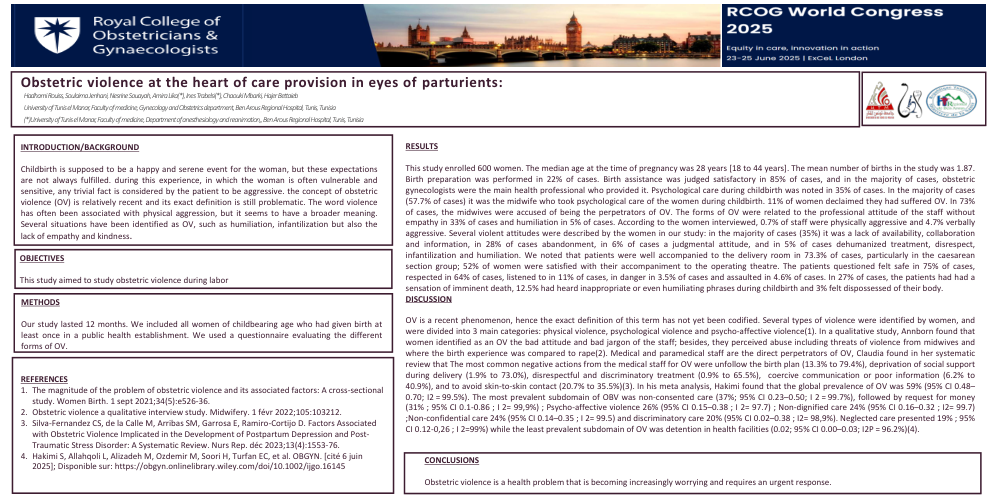
Obstetric violence at the heart of care provision in eyes of parturients:
Hadhami Rouiss, Soulaima Jenhani, Nesrine Souayah, Amira Lika(*), Ines Trabelsi(*), Chaouki Mbarki, Hajer Bettaieb
University of Tunis el Manar, Faculty of medicine, Gynecology and Obstetrics department, Ben Arous Regional Hospital, Tunis, Tunisia
(*)University of Tunis el Manar, Faculty of medicine, Department of anesthesiology and reanimation,, Ben Arous Regional Hospital, Tunis, Tunisia
Introduction :
childbirth is supposed to be a happy and serene event for the woman, but these expectations are not always fulfilled. during this experience, in which the woman is often vulnerable and sensitive, any trivial fact is considered by the patient to be aggressive. the concept of obstetric violence (OV) is relatively recent and its exact definition is still problematic. The word violence has often been associated with physical aggression, but it seems to have a broader meaning. Several situations have been identified as OV, such as humiliation, infantilisation but also the lack of empathy and kindness.
Objective : to study obstetric violence during labour
Design: This was a descriptive, cross-sectional, multicentre study.
Methods: Our study lasted 12 months. We included all women of childbearing age who had given birth at least once in a public health establishment. We used a questionnaire evaluating the different forms of OV.
Results: This study enrolled 600 women. The median age at the time of pregnancy was 28 years [18 to 44 years]. The mean number of births in the study was 1.87. Birth preparation was performed in 22% of cases. Birth assistance was judged satisfactory in 85% of cases, and in the majority of cases, obstetric gynaecologists were the main health professional who provided it. Psychological care during childbirth was noted in 35% of cases. In the majority of cases (57.7% of cases) it was the midwife who took psychological care of the women during childbirth. 11% of women declaimed they had suffered OV. In 73% of cases, the midwives were accused of being the perpetrators of OV. The forms of OV were related to the professional attitude of the staff without empathy in 33% of cases and humiliation in 5% of cases. According to the women interviewed, 0.7% of staff were physically aggressive and 4.7% verbally aggressive. Several violent attitudes were described by the women in our study: in the majority of cases (35%) it was a lack of availability, collaboration and information, in 28% of cases abandonment, in 6% of cases a judgmental attitude, and in 5% of cases dehumanised treatment, disrespect, infantilisation and humiliation. We noted that patients were well accompanied to the delivery room in 73.3% of cases, particularly in the caesarean section group; 52% of women were satisfied with their accompaniment to the operating theatre. The patients questioned felt safe in 75% of cases, respected in 64% of cases, listened to in 11% of cases, in danger in 3.5% of cases and assaulted in 4.6% of cases. In 27% of cases, the patients had had a sensation of imminent death, 12.5% had heard inappropriate or even humiliating phrases during childbirth and 3% felt dispossessed of their body.
Discussion
OV is a recent phenomenon, hence the exact definition of this term has not yet been codified. Several types of violence were identified by women, and were divided into 3 main categories: physical violence, psychological violence and psycho-affective violence(1). In a qualitative study, Annborn found that women identified as an OV the bad attitude and bad jargon of the staff; besides, they perceived abuse including threats of violence from midwives and where the birth experience was compared to rape(2). Medical and paramedical staff are the direct perpetrators of OV, Claudia found in her systematic review that The most common negative actions from the medical staff for OV were unfollow the birth plan (13.3% to 79.4%), deprivation of social support during delivery (1.9% to 73.0%), disrespectful and discriminatory treatment (0.9% to 65.5%), coercive communication or poor information (6.2% to 40.9%), and to avoid skin-to-skin contact (20.7% to 35.5%)(3). In his meta anlysis, Hakimi found that the global prevalence of OV was 59% (95% CI 0.48–0.70; I2 = 99.5%). The most prevalent subdomain of OBV was non-consented care (37%; 95% CI 0.23–0.50; I 2 = 99.7%), followed by request for money (31% ; 95% CI 0.1-0.86 ; I 2= 99,9%) ; Psycho-affective violence 26% (95% CI 0.15–0.38 ; I 2= 97.7) ; Non-dignified care 24% (95% CI 0.16–0.32 ; I2= 99.7) ;Non-confidential care 24% (95% CI 0.14–0.35 ; I 2= 99.5) and discriminatory care 20% (95% CI 0.02–0.38 ; I2= 98,9%). Neglected care presented 19% ; 95% CI 0.12-0,26 ; I 2=99%) while the least prevalent subdomain of OV was detention in health facilities (0.02; 95% CI 0.00–0.03; I2P = 96.2%)(4).
Conclusion:
Obstetric violence is a health problem that is becoming increasingly worrying and requires an urgent response.
Références :
1. The magnitude of the problem of obstetric violence and its associated factors: A cross-sectional study. Women Birth. 1 sept 2021;34(5):e526‑36.
2. Obstetric violence a qualitative interview study. Midwifery. 1 févr 2022;105:103212.
3. Silva-Fernandez CS, de la Calle M, Arribas SM, Garrosa E, Ramiro-Cortijo D. Factors Associated with Obstetric Violence Implicated in the Development of Postpartum Depression and Post-Traumatic Stress Disorder: A Systematic Review. Nurs Rep. déc 2023;13(4):1553‑76.
4. Hakimi S, Allahqoli L, Alizadeh M, Ozdemir M, Soori H, Turfan EC, et al. OBGYN. [cité 6 juin 2025]; Disponible sur: https://obgyn.onlinelibrary.wiley.com/doi/10.1002/ijgo.16145