2,281 posters, 63 videos, 56 audios, 43 topics, 18 sessions, 6,174 authors, 2,323 institutions
ePostersLive by SciGen Technologies S.A. All rights reserved.
RCOG World Congress 2025
June 23 - 25, 2025 | ExCeL London, UK
EP.1412
informationed consent during labour and delivery: the mute form of obstetric violence
Poster Presenter
Part of Topic
Intrapartum care
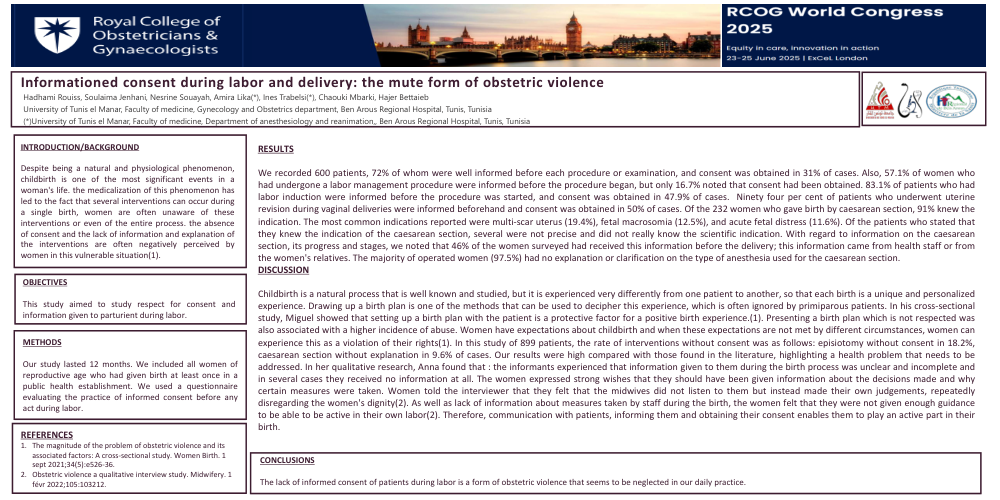
Informed consent during labour and delivery: the mute form of obstetric violence
Hadhami Rouiss, Soulaima Jenhani, Nesrine Souayah, Amira Lika(*), Ines Trabelsi(*), Chaouki Mbarki, Hajer Bettaieb
University of Tunis el Manar, Faculty of medicine, Gynecology and Obstetrics department, Ben Arous Regional Hospital, Tunis, Tunisia
(*)University of Tunis el Manar, Faculty of medicine, Department of anesthesiology and reanimation,, Ben Arous Regional Hospital, Tunis, Tunisia
Introduction :
despite being a natural and physiological phenomenon, childbirth is one of the most significant events in a woman's life. the medicalisation of this phenomenon has led to the fact that several interventions can occur during a single birth, women are often unaware of these interventions or even of the entire process. the absence of consent and the lack of information and explanation of the interventions are often negatively perceived by women in this vulnerable situation(1).
Objective: To study respect for consent and information given to parturients during labour.
Design: This was a descriptive, cross-sectional, multicentre study.
Method: Our study lasted 12 months. We included all women of reproductive age who had given birth at least once in a public health establishment. We used a questionnaire evaluating the practice of informed consent before any act during labour.
Results: We recorded 600 patients, 72% of whom were well informed before each procedure or examination, and consent was obtained in 31% of cases. Also, 57.1% of women who had undergone a labour management procedure were informed before the procedure began, but only 16.7% noted that consent had been obtained. 83.1% of patients who had labour induction were informed before the procedure was started, and consent was obtained in 47.9% of cases. Ninety four per cent of patients who underwent uterine revision during vaginal deliveries were informed beforehand and consent was obtained in 50% of cases. Of the 232 women who gave birth by caesarean section, 91% knew the indication. The most common indications reported were multi-scar uterus (19.4%), fetal macrosomia (12.5%), and acute fetal distress (11.6%). Of the patients who stated that they knew the indication of the caesarean section, several were not precise and did not really know the scientific indication. With regard to information on the caesarean section, its progress and stages, we noted that 46% of the women surveyed had received this information before the delivery; this information came from health staff or from the women's relatives. The majority of operated women (97.5%) had no explanation or clarification on the type of anaesthesia used for the caesarean section.
Discussion :
Childbirth is a natural process that is well known and studied, but it is experienced very differently from one patient to another, so that each birth is a unique and personalised experience. Drawing up a birth plan is one of the methods that can be used to decipher this experience, which is often ignored by primiparous patients. In his cross-sectional study, Miguel showed that setting up a birth plan with the patient is a protective factor for a positive birth experience.(1). Presenting a birth plan which is not respected was also associated with a higher incidence of abuse. Women have expectations about childbirth and when these expectations are not met by different circumstances, women can experience this as a violation of their rights(1). In this study of 899 patients, the rate of interventions without consent was as follows: episiotomy without consent in 18.2%, caesarean section without explanation in 9.6% of cases. Our results were high compared with those found in the literature, highlighting a health problem that needs to be addressed.
In her qualitative research, Anna found that : the informants experienced that information given to them during the birth process was unclear and incomplete and in several cases they received no information at all. The women expressed strong wishes that they should have been given information about the decisions made and why certain measures were taken. Women told the interviewer that they felt that the midwives did not listen to them but instead made their own judgements, repeatedly disregarding the women's dignity(2).
As well as lack of information about measures taken by staff during the birth, the women felt that they were not given enough guidance to be able to be active in their own labour(2). Therefore, communication with patients, informing them and obtaining their consent enables them to play an active part in their birth.
Conclusions: The lack of informed consent of patients during labour is a form of obstetric violence that seems to be neglected in our daily practice.
Références :
1. The magnitude of the problem of obstetric violence and its associated factors: A cross-sectional study. Women Birth. 1 sept 2021;34(5):e526‑36.
2. Obstetric violence a qualitative interview study. Midwifery. 1 févr 2022;105:103212.