2,281 posters, 63 videos, 56 audios, 43 topics, 18 sessions, 6,174 authors, 2,323 institutions
ePostersLive by SciGen Technologies S.A. All rights reserved.
RCOG World Congress 2025
June 23 - 25, 2025 | ExCeL London, UK
EP.1411
Induced Labor in Focus: Evaluating Trends, Complications, and Delivery Success Rates
Poster Presenter
Authors
Saba Ansari, mariam iqbal, rubab khalid, asifa noren, kanwal nosheen, rubina sohail
Affiliations
IMC Hospital, horison hospital, SIMS, hameed Lateef hospital
Part of Topic
Intrapartum care
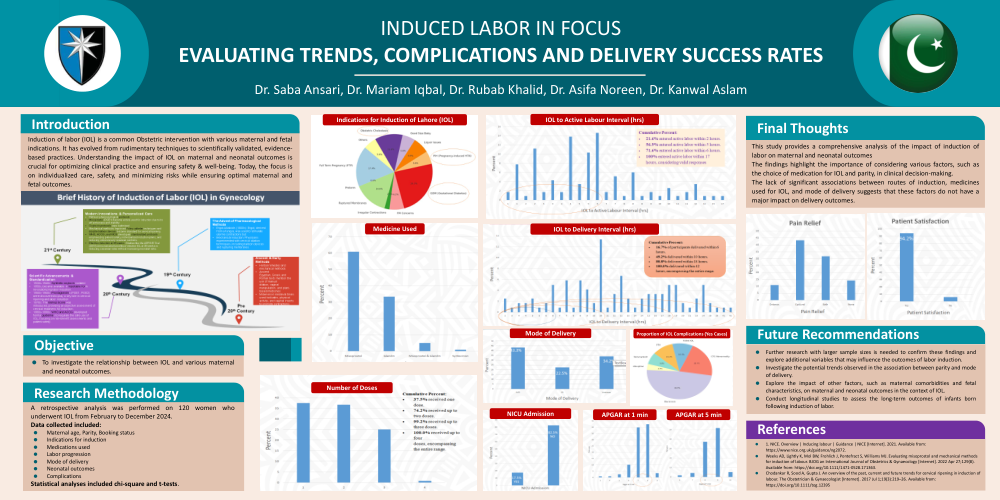
"Induced Labor in Focus: Evaluating Trends, Complications, and Delivery Success Rates"
Authors: Dr Saba Ansari, Dr Mariam Iqbal, Dr Rubab Khalid, Dr Asifa Noreen, Dr Kanwal Aslam
Introduction:
Induction of labor (IOL) is a common Obstetric intervention with various maternal and fetal indications.
It has evolved from rudimentary techniques to scientifically validated, evidence-based practices.
Understanding the impact of IOL on maternal and neonatal outcomes is crucial for optimizing clinical practice and ensuring safety & well-being.
Today, the focus is on individualized care, safety, and minimizing risks while ensuring optimal maternal and fetal outcomes.
Brief History of Induction of Labor (IOL) in Gynecology:
Put in the slide from ppt
Research objectives:
To investigate the relationship between
- between IOL and various maternal and neonatal outcomes.
- To identify significant factors influencing these outcomes.
Research methodology:
A retrospective analysis was performed on 120 women who underwent IOL from February to December 2024.
Data collected included
§ Maternal age, Parity, Booking status
§ Indications for induction
§ Medications used
§ Labor progression
§ Mode of delivery
§ Neonatal outcomes
§ Complications
Statistical analyses included chi-square and t-tests.
Final thoughts:
this study provides a comprehensive analysis of the impact of induction of labor on maternal and neonatal outcomes
The findings highlight the importance of considering various factors, such as the choice of medication for IOL and parity, in clinical decision-making.
The lack of significant associations between rou
routes of induction, medicines used for IOL, and mode of delivery suggests that these factors do not have a major impact on delivery outcomes.
Recommendations for Future Research:
Further research with larger sample sizes is needed to confirm these findings and explore additional variables that may influence the outcomes of labor induction.
Investigate the potential trends observed in the association between parity and mode of delivery.
Explore the impact of other factors, such as maternal comorbidities and fetal characteristics, on maternal and neonatal outcomes in the context of IOL.
Conduct longitudinal studies to assess the long-term outcomes of infants born following induction of labor.
references:
1. NICE. Overview | Inducing labour | Guidance | NICE [Internet]. 2021. Available from: https://www.nice.org.uk/guidance/ng207
2. Weeks AD, Lightly K, Mol BW, Frohlich J, Pontefract S, Williams MJ. Evaluating misoprostol and mechanical methods for induction of labour. BJOG an International Journal of Obstetrics & Gynaecology [Internet]. 2022 Apr 27;129(8). Available from: https://doi.org/10.1111/1471-0528.17136
3. Chodankar R, Sood A, Gupta J. An overview of the past, current and future trends for cervical ripening in induction of labour. The Obstetrician & Gynaecologist [Internet]. 2017 Jul 1;19(3):219–26. Available from: https://doi.org/10.1111/tog.12395