2,281 posters, 63 videos, 56 audios, 43 topics, 18 sessions, 6,174 authors, 2,323 institutions
ePostersLive by SciGen Technologies S.A. All rights reserved.
RCOG World Congress 2025
June 23 - 25, 2025 | ExCeL London, UK
EP.1410
Gravity in Labour: Is There Any Value In The Birthing Chair?
Part of Topic
Intrapartum care
Title: Gravity in Labour: Is There Any Value To the Birthing Stool?
Authors: Miss Sarah Atalla, Mr Rami Atalla (Chelsea & Westminster Hospital, London. Lister Hospital, Stevenage.)
Objective: The birthing stool has been studied and appears to be beneficial to shorten labour. However, it is not clear if these advantages are due to the addition of gravity force in the upright position or because of other factors such as mobilisation and changes in pelvic axis. It has been assumed that gravity contributes significantly to these benefits especially in the later stages of labour.
Design: We calculated the proportion of the added contribution of gravity by adopting upright position in labour and whether this significantly benefits outcomes.
Method: We formulated a mathematical equation to calculate the gravity force that an upright position contributes to the forces exerted on the presenting part in the first and second stage of labour. The peak uterine pressure in first stage of labour is 50-80 mmHg and this increases to 100-150mmHg during the second stage2. We also compared the finding to the additional pulling force of instrumental delivery in lithotomy position.
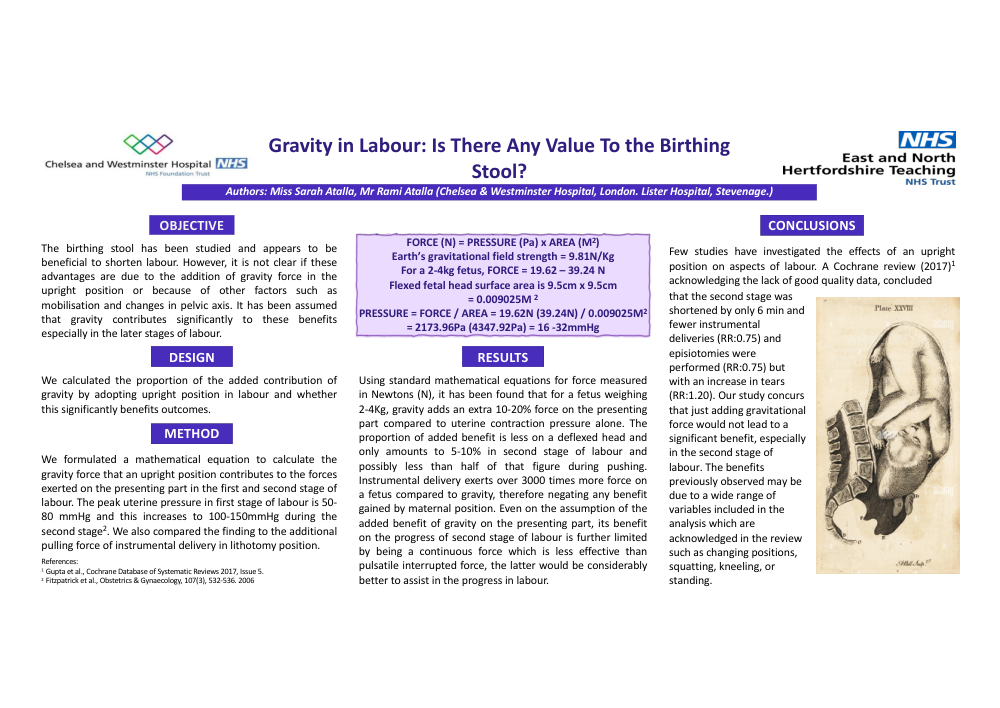
Results: Using standard mathematical equations for force measured in Newtons (N), it has been found that for a fetus weighing 2-4Kg, gravity adds an extra 10-20% force on the presenting part compared to uterine contraction pressure alone. The proportion of added benefit is less on a deflexed head and only amounts to 5-10% in second stage of labour and possibly less than half of that figure during pushing. Instrumental delivery exerts over 3000 times more force on a fetus compared to gravity, therefore negating any benefit gained by maternal position. Even on the assumption of the added benefit of gravity on the presenting part, its benefit on the progress of second stage of labour is further limited by being a continuous force which is less effective than pulsatile interrupted force, the latter would be considerably better to assist in the progress in labour.
Conclusions: Few studies have investigated the effects of an upright position on aspects of labour. A Cochrane review (2017)1 acknowledging the lack of good quality data, concluded that the second stage was shortened by only 6 min and fewer instrumental deliveries (RR:0.75) and episiotomies were performed (RR:0.75) but with an increase in tears (RR:1.20). Our study concurs that just adding gravitational force would not lead to a significant benefit, especially in the second stage of labour. The benefits previously observed may be due to a wide range of variables included in the analysis which are acknowledged in the review such as changing positions, squatting, kneeling, or standing.