2,281 posters, 63 videos, 56 audios, 43 topics, 18 sessions, 6,174 authors, 2,323 institutions
ePostersLive by SciGen Technologies S.A. All rights reserved.
RCOG World Congress 2025
June 23 - 25, 2025 | ExCeL London, UK
EP.1401
Predictive factors for cesarean section in low risk primiparas during labour
Poster Presenter
Authors
Affiliations
Department of Gynaecology and Obstetrics, Charles Nicolle Hospital, Department B- Charles Nicolle Hospital, Gynaecology and Obstetrics Department B, Charles Nicolle Hospital, Department Bof Obstetrics and Gynaecology, Charles Nicolle Hospital, Department of Obstetrics and Gynecology B, Charles Nicolle Hospital, Gynaecology and Obstetrics Department B of Charles Nicolle Hospital, Gynaecology and Obstetrics department B- Charles Nicolle Hospital, Charles Nicolle Hospital, Obstetrics and Gynaecology Service B, Department B of Gynaecology and Obstetrics- Charles Nicolle Hospital, Department B of Obstetrics and Gynecology, Charles Nicolle Hospital
Part of Topic
Intrapartum care
Predictive factors for cesarean section in low risk primiparas during labour
Objective:
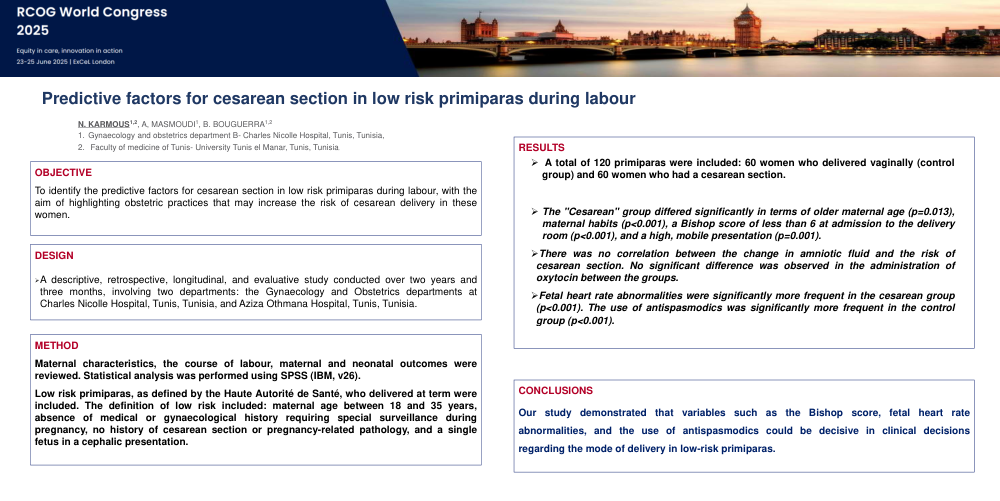
To identify the predictive factors for cesarean section in low risk primiparas during labour, with the aim of highlighting obstetric practices that may increase the risk of cesarean delivery in these women.
Design:
A descriptive, retrospective, longitudinal, and evaluative study conducted over two years and three months, involving two departments: the Gynaecology and Obstetrics departments at Charles Nicolle Hospital, Tunis, Tunisia, and Aziza Othmana Hospital, Tunis, Tunisia.
Method:
Maternal characteristics, the course of labour, maternal and neonatal outcomes were reviewed. Statistical analysis was performed using SPSS (IBM, v26).
Low risk primiparas, as defined by the Haute Autorité de Santé, who delivered at term were included. The definition of low risk included: maternal age between 18 and 35 years, absence of medical or gynaecological history requiring special surveillance during pregnancy, no history of cesarean section or pregnancy-related pathology, and a single fetus in a cephalic presentation.
A total of 120 primiparas were included: 60 women who delivered vaginally (control group) and 60 women who had a cesarean section.
Results:
The "Cesarean" group differed significantly in terms of older maternal age (p=0.013), maternal habits (p<0.001), a Bishop score of less than 6 at admission to the delivery room (p<0.001), and a high, mobile presentation (p=0.001).
There was no correlation between the change in amniotic fluid and the risk of cesarean section. No significant difference was observed in the administration of oxytocin between the groups.
Fetal heart rate abnormalities were significantly more frequent in the cesarean group (p<0.001). The use of antispasmodics was significantly more frequent in the control group (p<0.001).
Conclusions:
Our study demonstrated that variables such as the Bishop score, fetal heart rate abnormalities, and the use of antispasmodics could be decisive in clinical decisions regarding the mode of delivery in low-risk primiparas.