2,281 posters, 63 videos, 56 audios, 43 topics, 18 sessions, 6,174 authors, 2,323 institutions
ePostersLive by SciGen Technologies S.A. All rights reserved.
RCOG World Congress 2025
June 23 - 25, 2025 | ExCeL London, UK
EP.1400
Uterine inversion associated Neurogenic Shock, does it exist?
Poster Presenter
Authors
Affiliations
Part of Topic
Intrapartum care
Title: Uterine inversion associated Neurogenic Shock, does it exist?
Author: Janos Dancso consultant
Scunthorpe General Hospital
Introduction:
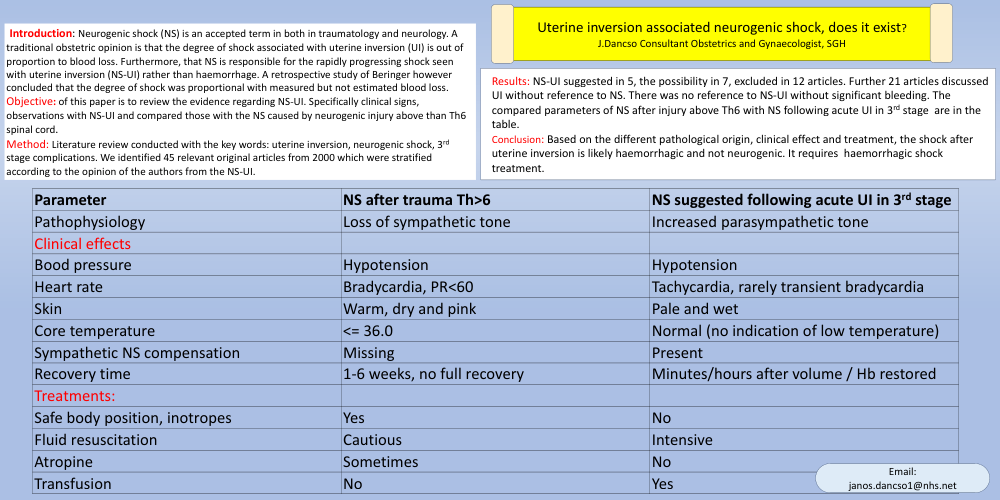
Neurogenic shock (NS) term is accepted in both traumatology and neurology. The traditional obstetric opinion that the degree of shock associated with uterine inversion (UI) is out of proportion of the blood loss. NS associated with Uterine Inversion (NS-UI) was suggested for the quickly progressing shock. A retrospective study of Beringer concluded that the degree of shock was proportional with measured but not the estimated blood loss. The objective of this paper is to review the evidence regarding NS-UI. Specifically clinical signs, observations with NS-UI and compared those with the NS caused by neurogenic injury above than Th6 spinal cord.
Method:
Literature review conducted with the key words: uterine inversion, neurogenic shock, 3rd stage complications. This identified 45 relevant original articles which were stratified according to the opinion of the authors from the NS-UI. NS-UI suggested in 5, the possibility in 7, excluded in 12 articles. Further 21 article discussed UI without reference to NS.
Results:
12/45 of articles considered presence or possibility of NS-UI. 33/45 of the article did not consider or could not confirm NS-UI. There was no reference to NS-UI without significant bleeding. The articles with NS-UI rarely documented observations, symptoms and signs.
I compared the NS characteristics from patients after high spinal cord injury with the NS-UI obstetric patients
NS after trauma>T6 Observed with UI and suggested NS
History and Cause Central nervous damage Acute puerperal uterine inversion
Pathophysiology Loss of sympathetic tone Increased parasympathetic tone
Decreased vascular resistance Haemorrhage, hypovolaemic shock
Clinical effects
Blood pressure Hypotension Hypotension
Heart rate Bradycardia, pulse rate<60 Tachycardia, very rarely bradycardia
Skin Warm, pink, dry Pale and wet
Core temperature 36.0 C or lower normal
Sympathetic NS
Compensation Missing present
Recovery time weeks Soon after volume/Hb restored
Full recovery Life-time card Usually within hours-days
Treatment
Safe body position Yes no
Inotrope Dopamine, norepinephrine no
Vasopressin, ADH Ephedrine no
Fluid resuscitation Cautious Rapid
Atropine Sometimes no
Transfusion No yes.
Conclusion:
The review could not confirm evidence of NS-UI. The observations suggest haemorrhagic instead of a neurogenic shock. A false diagnosis can delay the correct treatment, have further risks for the patient, mislead learning opportunities and have legal implications.