2,281 posters, 63 videos, 56 audios, 43 topics, 18 sessions, 6,174 authors, 2,323 institutions
ePostersLive by SciGen Technologies S.A. All rights reserved.
RCOG World Congress 2025
June 23 - 25, 2025 | ExCeL London, UK
EP.1397
Long term neurological outcomes in survivors of foetomaternal haemorrhage: A systematic review
Poster Presenter
Authors
Abeer Hussein, David Howe, Brigitte Vollmer, Fenella Kirkham
Affiliations
Part of Topic
Intrapartum care
Long term neurological outcomes in survivors of foetomaternal haemorrhage: A systematic review
Abstract
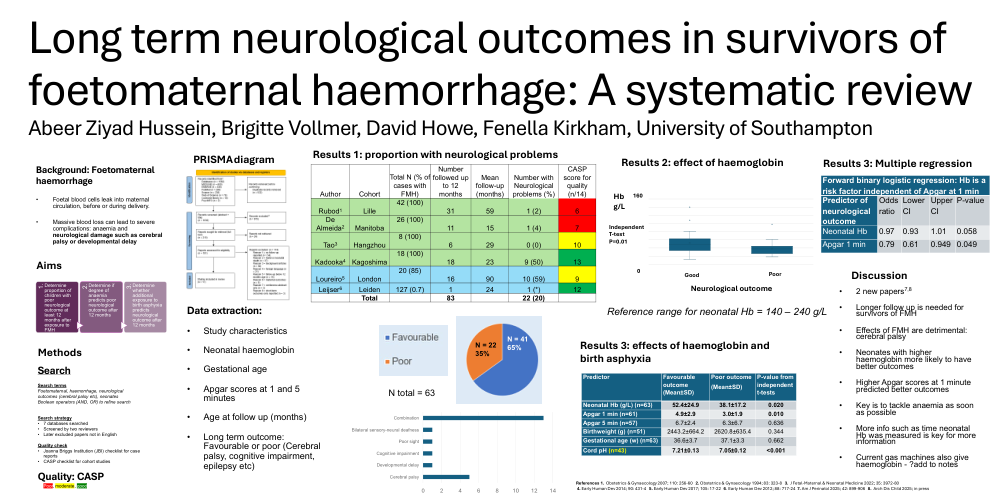
Objective: Foetomaternal haemorrhage (FMH) is an obstetric emergency which, if acute and massive can lead to stillbirth or neurological sequelae in survivors, but data is scarce. A systematic review was undertaken to evaluate reported long-term neurological outcomes on neonates after foetomaternal haemorrhage and their predictors.
Methods: Publications were identified via EMBASE, PsycINFO, PubMed, Web of Science, Scopus, OVID and the Cochrane library, using terms relating to foetomaternal haemorrhage and neurological outcomes. Papers were screened by 2 reviewers, initially by titles and abstract, then by full texts. Included studies focused only on survivors with a minimum of 12 months follow up. Data were extracted and a binary logistic regression was performed to compare clinical and laboratory variables in poor and good outcome patients. Studies were quality assessed via the CASP or Joanna Briggs criteria for case reports.
Results: Seventeen studies were included, comprising 6 retrospective case series with outcomes: (4 only reporting FMH (n=31, 18, 11, 6), and 2 focusing on foetal (FMH in 1/127 cases eligible for in utero transfusion) or neonatal (FMH in 16/20 cases) anaemia. Five presented individual laboratory data, and were included in the individual data analysis, alongside 11 case reports. Of 63 cases with median long-term follow up of 24 (12-112) months, 41 (65%) demonstrated favourable outcome and 22 with poor outcome 35% (15 (24%) had cerebral palsy and 7 (11%) had other adverse cognitive-behavioural sequelae). Apgar score at 1 minute (OR=0.79; [95% CI 0.61-0.99]) and low neonatal haemoglobin (OR=0.97 [95% CI 0.93-1.0]) independently predicted poor outcome. Transfusion in the neonatal period was mentioned in 20 cases.
Conclusion: This systematic review suggests that haemoglobin levels and Apgar 1 minute scores are associated with neurological outcome. However, the available data lacks clarity on the timing of neonatal haemoglobin measurements and transfusions. A recent matched case-control retrospective study by Pettway et al (PMID:39532114), published after this search, reviewed the developmental and cognitive outcomes of 260 neonates surviving FMH in comparison to those not exposed. Interestingly, of 137 with clinically significant FMH, 80 were intrauterine deaths while 57 were transfused as neonates; four died in the neonatal period but there was no observed difference in neurodevelopmental diagnoses in the 53 long term survivors in comparison to the matched unexposed infants. Longer follow up is needed for survivors of FMH. This review highlights the need for more focused, prospective studies so that appropriate guidelines to improve outcome can be developed.