2,281 posters, 63 videos, 56 audios, 43 topics, 18 sessions, 6,174 authors, 2,323 institutions
ePostersLive by SciGen Technologies S.A. All rights reserved.
RCOG World Congress 2025
June 23 - 25, 2025 | ExCeL London, UK
EP.1396
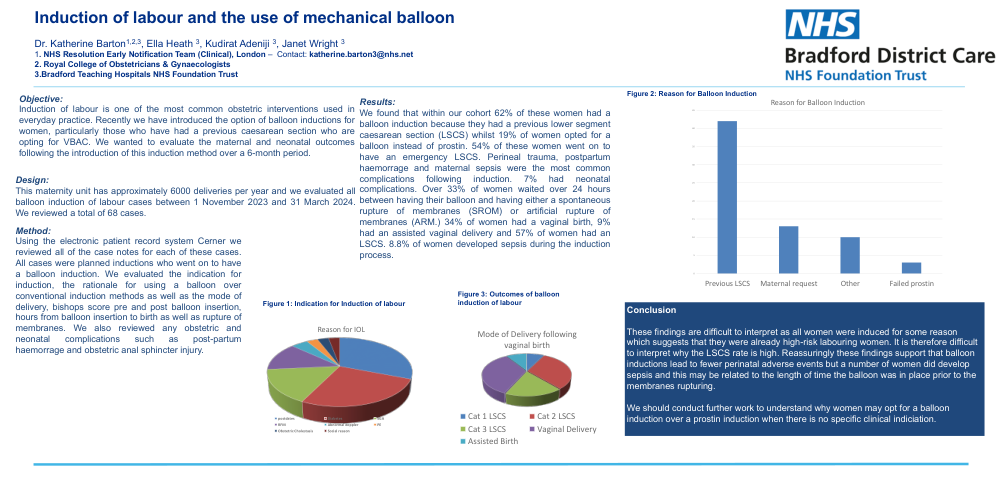
Induction of labour and the use of the mechanical balloon
Part of Topic
Intrapartum care
Induction of labour using a mechanical balloon and associated outcomes
Objective:
Induction of labour is one of the most common obstetric interventions used in everyday practice. Recently we have introduced the option of balloon inductions for women, particularly those who have had a previous caesarean section who are opting for VBAC. We wanted to evaluate the maternal and neonatal outcomes following the introduction of this induction method over a 6-month period.
Design:
This maternity unit has approximately 6000 deliveries per year and we evaluated all balloon induction of labour cases between 1 November 2023 and 31 March 2024. We reviewed a total of 68 cases.
Method:
Using the electronic patient record system Cerner we reviewed all of the case notes for each of these cases. All cases were planned inductions who went on to have a balloon induction. We evaluated the indication for induction, the rationale for using a balloon over conventional induction methods as well as the mode of delivery, bishops score pre and post balloon insertion, hours from balloon insertion to birth as well as rupture of membranes. We also reviewed any obstetric and neonatal complications such as post-partum haemorrage and obstetric anal sphincter injury.
Results:
We found that within our cohort 62% of these women had a balloon induction because they had a previous lower segment caesarean section (LSCS) whilst 19% of women opted for a balloon instead of prostin. 54% of these women went on to have an emergency LSCS. Perineal trauma, postpartum haemorrage and maternal sepsis were the most common complications following induction. 7% had neonatal complications. Over 33% of women waited over 24 hours between having their balloon and having either a spontaneous rupture of membranes (SROM) or artificial rupture of membranes (ARM.) 34% of women had a vaginal birth, 9% had an assisted vaginal delivery and 57% of women had an LSCS. 8.8% of women developed sepsis during the induction process.
Conclusions:
These findings are difficult to interpret as all women were induced for some reason which suggests that they were already high-risk labouring women. It is therefore difficult to interpret why the LSCS rate is high. Reassuringly these findings support that balloon inductions lead to fewer perinatal adverse events but a number of women did develop sepsis and this may be related to the length of time the balloon was in place prior to the membranes rupturing.